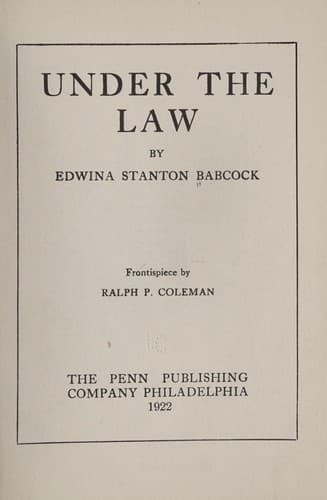
Amnesiacs -- Fiction; New York (State) -- Social life and customs -- Fiction; Trials -- Fiction; Young women -- Fiction
Not to accept dogma--to be ready for the new light, to trim one's
mental sails for the breeze from a fresh quarter, it had given the
great criminal lawyer a profound insight into the human heart, an
almost awful power over the souls of men. Wastrel after wastrel had
tried to look Watts Shipman in the eye, and had known that some strange
God of Equity sat watchful in this man--that only in proportion to
their actual guilt would they be dealt with. Men and women had broken
down and told him all, only because of the unendurable patience and
remorseless gravity of his uncondemning gaze. He had fathered many a
boy and stood many a woman on her own feet, and yet Life, the Great
Mother, had held back from him what he, as human, knew must be the
ultimate and only gift. Women had angled for Watts Shipman because of
his fame; they had tried to use him politically; they had trusted him,
feared him and been penitent before him. No woman had ever loved him.
Staring at the Victory, the man smoked silently. Half ruefully he
passed his hand over the russet head on his knee, he threw back his own
great black-haired head with its dapple of white spots; he stretched
his long limbs and his deep-lined humorous face saddened. "Women want
to play," he said softly, "uncertain, funny little things, they want
to play"--tenderly, "and, not necessarily, to play fair--and I'm no
plaything, although," he waved his pipe toward the bas-relief over the
fire piece, "I could play with you, Miss Victory."
The word play made him think of something; pushing away the dog, Watts
rose and went to a table drawer, taking out, with a smile, a little
envelope with "Pudge" scrawled on it. The lawyer, still smiling, slid
out the contents, two Indian arrow-heads, one white, the other gray
flint. Thoughtfully he turned them over in his large palm. "Poor good
little Indians," he murmured, "we're still teaching our children that
you were devils, aren't we? Aren't we funny? We rather owe you an
apology, you strange, mysterious men who never knew fulfilment--who
ranged these Hudson River shores and thronged New Jersey and New
England and were mighty hunters and happy until you came up against the
white man and gunpowder and tobacco and whiskey! Well"--Watts chuckled,
"Pudgy shan't be prejudiced. I'll write you a good character for him."
Knocking his pipe out, laying it tenderly on the mantel, the big man
sprawled like a schoolboy over the table writing in long hand the
letter that was to accompany the arrow-heads.
Public-domain text, read in full here on John Shaqi.
Reviews
Reviews
No reviews yet
Be the first to share your thoughts on this work.
Join the Discussion
Join the discussion
Sign in to leave a comment or review.
Sign InorCreate an account