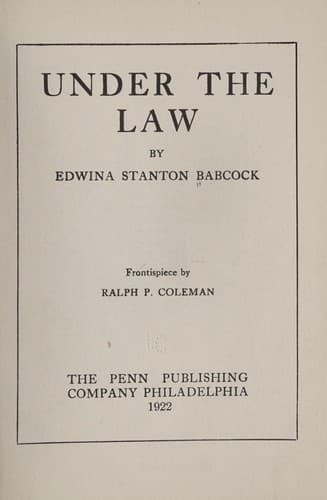
Amnesiacs -- Fiction; New York (State) -- Social life and customs -- Fiction; Trials -- Fiction; Young women -- Fiction
Lounging to their feet they made ready to follow her but Sard, older
and steadier, restrained them. "That's idiotic," the girl said
abruptly--"you don't know what a rage it would put Dad in, Minga!
You've never seen him when he's really angry."
"Does he carry on some?" asked one of the boys.
Sard was silent for a moment, then, "He is quite terrible," she
said quietly; "it would make things worse in every way to go to Dad
now--besides you know as well as I do that he could officially do
nothing, but," Sard, looking at them all, spoke low, "I have an idea,
I've been thinking."
They always listened respectfully to Sard. She was the stuff of which
leaders are made. Indifferent to popularity, caring only for the
enterprise in which she was engaged, cool, controlled, just as she was
in card games or swimming and tennis, now she took charge of the group
as she had done a hundred times before.
"There's that famous lawyer who is spending the summer in the organ
builder's house on the mountain; you know about him."
"Don't I," spoke up Minga, eagerly. "He's a great friend of my Cousin
Eleanor Ledyard and her little Pudge; he writes Pudge the funniest
letters.... My!" sighed Minga. "He's frightfully important; he's been
counsel for all the millionaires and magnates, he has eyes like X-rays,
they look you through and through. Wow! I'm afraid of him."
The other girl hesitated. "He's famous and all that," she said slowly.
"Father knows him well, but I've read things he has written in the
magazines and--and--he isn't--well, you know how things are done?" The
group, curiously enough, in spite of no reading at all, did know how
things are done. How fatally the lies, the subsidizing, the political
trickery and chicanery persist in spite of the smug assumptions of
virtues; the falsity of the effort to push the world back to an age
where just the title of "Christian" would suffice instead of the more
recent challenge which insists that the Christian be like Christ. They
knew, these little sated, over-indulged, inexperienced sprouts of
materialism, somehow or other, they knew.
"The loss of innocence" which their elders so much deplored has given
them a cool fatal knowledge of the rottenness hitherto hidden from
them; they know the failures and compromises upon which that æsthetic
dream of "innocence" has been dreamed. They will have none of it.
Minga chasséd to the terrace steps; she pinned a scarf around her
head turban-fashion and her eyes shone with adventurous gleam. "Say,
listen," she said in the vernacular--"Say--listen--let's all pile in
the machines and go up there on the mountain and stand in a row before
Watts Shipman. Let's ask him to take Terence's case; let's ask him if
he could get Terry off from a life's sentence. All of us--Yes. What?
Serve Judgie right," added Minga, indignantly, "for not being willing
to talk to me about it."
Public-domain text, read in full here on John Shaqi.
Reviews
Reviews
No reviews yet
Be the first to share your thoughts on this work.
Join the Discussion
Join the discussion
Sign in to leave a comment or review.
Sign InorCreate an account