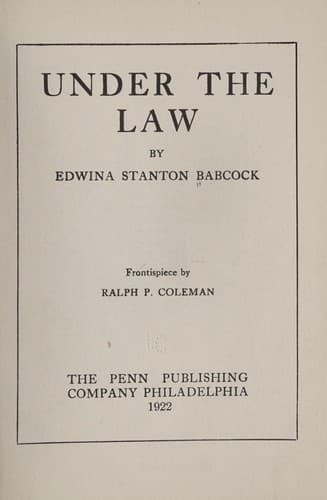
Amnesiacs -- Fiction; New York (State) -- Social life and customs -- Fiction; Trials -- Fiction; Young women -- Fiction
I don't even know whether to go on letting him have his own name, his
father's name, now disgraced and tragic, but how can I stop things?
He is his father, he has his mouth, the beautiful, fateful mouth that
always made me feel as if I were a ship, wrecked on it, and he has his
hair and his voice and his reckless and beseeching ways. Oh, Watts,
you saved my husband, all there was to save, brought him back home;
though you couldn't save him from himself.
Thanks for the arrow-heads, Watts, and please write me when you like.
You seem to think I might not care to hear. I have known why it was
always Pudge you wrote to, but I have grown a little stronger, a
little less like a wounded animal that wants to bite the hand held out
to it. I hope your mountain top still holds the peace you first found
there.
It was this letter that Watts Shipman saved until after his dinner,
cooked by himself on a camp-fire out under the trees and served deftly
and frugally with a sort of hermit cleanliness and economy. His pipe
lit, the russet head of Friar Tuck on his knee, the man read and reread
the pages. The deep eyes with their curiously grave and faithful look
were puzzled, the long hands gripped once or twice on the paper, and
the mouth curled down on the pipe-stem with a look of bafflement and
grim disappointment.
"Pshaw!" Watts kicked away a twig. He changed his position on the log
upon which he sat. Putting the letter safely in an inside pocket,
he got out his knife and cut rather restlessly into a long smear of
yellow lichen on a tree. "It's rather queer that a woman can talk like
that, hold out her signal of distress and then not tell you she needs
you--it's a queer thing," said Watts solemnly to his dog. "It's a queer
thing, only a good woman can withhold her _self_; a bad woman can be
subtle and elusive, a funny little beast, plotting, dreaming greedy,
little clawing dreams and setting out her little poison traps for you,
but a good woman merely draws the veil and you--well, Tuck, all you can
do is to go home!"
Watts spoke the last words so loudly that Friar Tuck rose once. "Woof,
woof," he barked loudly into his master's face. Watts laughed. "Hush,
you baby, I know I said 'go home,' but I'm not going home, Tuck, no
sir, not to those comfortable, luxurious bachelor apartments, not until
I've roughed it a little longer and get the wisdom and rightness of the
woods into me. For we can't take another whole summer off like this,
boy, for a long time. We've got to make it last, you old blasé clubman."
Public-domain text, read in full here on John Shaqi.
Reviews
Reviews
No reviews yet
Be the first to share your thoughts on this work.
Join the Discussion
Join the discussion
Sign in to leave a comment or review.
Sign InorCreate an account