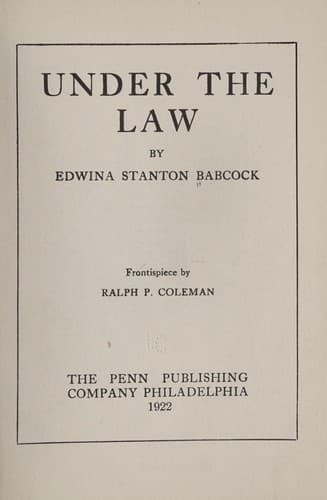
Amnesiacs -- Fiction; New York (State) -- Social life and customs -- Fiction; Trials -- Fiction; Young women -- Fiction
The lawyer instinctively admired the girl for her directness, and he
met her with equal directness. "No," he said, "we haven't, no one has,
under any circumstances, the right to take life but in such cases
we choose a lesser evil instead of a perfect good. Here the problem
is that this boy, for a small amount of money, wantonly killed an
old man, who had befriended him, trusted him; 'murder,'" said Watts
emphatically, "is on his soul--do you think he would have strength to
live again?"
It was stated very simply, but with such unadorned clearness that Sard
shivered. Shipman, without speaking, got up and went into the house,
presently emerging with some light steamer rugs and Italian blankets,
one of which he drew around Sard's shoulders. He motioned in a big
brotherly way to the somewhat subdued girls of the party, "I'm afraid
you're all cold. Shall we go in? Haven't you sweaters or something?"
But something stiff in this little party made them refuse to enter the
house; it might almost have been that this strange man who lived in
the organ builder's house had so impressed them by a sense of inherent
personal power that they felt actually safer outdoors. Anyway, Minga,
the little scarlet leader of all their pranks and escapades, their
rather elaborately planned defiances and simulated viciousness, had
been shamed by this man. Sard, it seemed, also remembered it; however,
she did not refuse the Italian blanket, though she let it slip to
her knees. The lawyer noted this, and the corners of his mouth moved
slightly.
He turned to the younger practitioner of his profession. "It is an ugly
case," he remarked gravely. "The way it was done," he made a gesture of
disgust, "the boy must have something essentially sneaky and cold in
him. There are natures like that," he turned to Sard, "natures that you
could hardly, with all your imagination, realize or comprehend."
So the group sat in the moonlight discussing the thing. One by one the
lawyer drew the young philanthropists out. Under the rather marked
paucity of expression he found the same impulse, the broad human wish
to give this boy, caught like a fly in the net of the law, "another
chance." Watts quietly relaxed, sat there in the moonlight, studying
the sober young faces. Finally he spoke the thing that had first of all
come into his mind.
"Perhaps I ought not to ask this," turning to Sard, "but your father,
in this county, is the Law and Prophets. The country people dote on
his judgments; they trust him; somehow I should think no lawyer would
influence his decision, no jury's verdict interfere with his sentence.
He, I should think in talking with you, would be able to make you feel
the essential inevitability of the thing."
Public-domain text, read in full here on John Shaqi.
Reviews
Reviews
No reviews yet
Be the first to share your thoughts on this work.
Join the Discussion
Join the discussion
Sign in to leave a comment or review.
Sign InorCreate an account