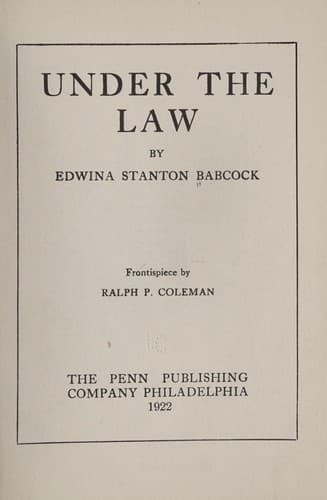
Amnesiacs -- Fiction; New York (State) -- Social life and customs -- Fiction; Trials -- Fiction; Young women -- Fiction
Shipman rather enjoyed the little drama being enacted before him; he
smoked imperturbably while he appeared to give this answer thought. "I
suppose we ought to remember that the law that makes divorce possible
rose first in the minds of men and women," he said evenly. "But we
must ask ourselves how well those minds are instructed. In any case,
I take it, the law, no matter how badly interpreted, is society's
weapon against itself! New laws put upon paper and framed by act of
Legislature or of Congress are to counteract certain old laws which
were inadequate. When I insisted that your little friend extinguish
her cigarette," the lawyer gravely searched the darkening faces in the
moonlight, "it was merely to enforce a law which makes forest fires
less probable. When I enact a law that separates a good woman from a
bad man or vice versa, I protect the weaker against the stronger; when
I support a law that insists that a boy's liberty be taken from him,
after a dastardly murder, I make it possible for people to move about
with varying degrees of safety from like murder. It is not my affair if
these laws are not modified. It is for you and people like you to keep
laws and by keeping them gain the power to make better ones."
The circle, a little daunted by his calm willingness to discuss, were
disposed to receive this without comment. The little lawyer in the owl
glasses kicked rather disconsolately at a bunch of turf, the other
lads fidgeted. Somehow the crusade to intercede on behalf of Terence
O'Brien had lost its moving-picture sensationalism. They realized that
they had run up against a quiet man of steel and iron, who was more
or less amused and not very impressed by them; there were murmurings
and half-formed suggestions that they should leave until Sard, with a
kind of resolution, rose suddenly from her seat and stood in front of
Shipman. She looked directly into his face and he saw determination in
her; the sort that does and dies, but does not abandon its object.
"I--I believe you are kind," said the girl, in a low questioning tone.
The man, a little surprised, waited gravely.
Sard spoke rather timidly. "I understand how you and other lawyers look
at these things, by rote, sort of, isn't it? And you forget it is men
and women you deal with; only 'cases' and knotty 'points,' isn't that
true?"
Watts, rather piqued, bowed in answer.
"And I know," said Sard quickly--"it seems queer to ask it, but you, a
man of your power, could influence a country jury, couldn't you, from
your way of putting a thing, from your knowledge of how to speak to the
point? Would you," the girl looked eagerly into the half-shadowed face,
"would you be willing to appear for Terry's defense if--we--we paid you
any fee you asked? I think we could get the money some way." The girl
was clearly nervous now; her breath came a little quicker as she stood
her ground, saying simply, helplessly, "Would you?"
Public-domain text, read in full here on John Shaqi.
Reviews
Reviews
No reviews yet
Be the first to share your thoughts on this work.
Join the Discussion
Join the discussion
Sign in to leave a comment or review.
Sign InorCreate an account