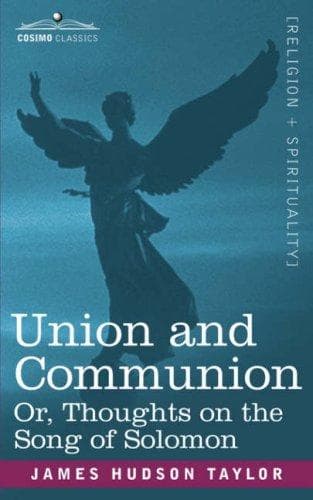
Union and Communion; or, Thoughts on the Song of SolomonTaylor, James Hudson
Religion
Union and Communion; or, Thoughts on the Song of Solomon
Taylor, James Hudson
Bible. Song of Solomon -- Commentaries
The connection is, we believe, one of great importance, teaching us
that what she _was_ (by grace) was more important than what she _did_;
and that she did not work in order to earn favour, but being assured of
favour, gave her love free scope to show itself in service. The bride
knew her relationship to her LORD, and His love to her; and in her
determination that He should have the thousand pieces of silver, her
concern was that her vineyard should not produce less for her Solomon
than His vineyard at Baal-hamon; her vineyard was herself, and she
desired for her LORD much fruit. She would see, too, that the keepers of
the vineyard, those who were her companions in its culture, and who
ministered in word and doctrine, were well rewarded; she would not
muzzle the ox that treadeth out the corn; a full tithe, nay a double
tithe, was to be the portion of those who kept the fruit and laboured
with her in the vineyard.
* * * * *
How long this happy service continues, and how soon it is to be
terminated, we cannot tell; He who calls His servants to dwell in the
gardens, and cultivate them for Him--as Adam of old was placed in the
paradise of GOD--alone knows the limit of this service. Sooner or later
the rest will come, the burden and heat of the last day will have been
borne, the last conflict will be over, and the voice of the Bridegroom
will be heard addressing His loved one:--
Thou that dwellest in the gardens,
The companions hearken to thy voice:
Cause Me to hear it.
Thy service among the companions is finished; thou hast fought the good
fight, thou hast kept the faith, thou hast finished thy course;
henceforth there is laid up for thee the crown of righteousness, and the
Bridegroom Himself shall be thine exceeding great reward!
Well may the bride let Him hear her voice, and, springing forth in heart
to meet Him, cry:--
Make haste, my Beloved,
And be Thou like to a roe or to a young hart
Upon the mountains of spices!
She no longer asks Him, as in the second section:--
Turn, my Beloved, and be Thou like a roe or a young
hart
Upon the mountains of Bether [separation].
She has never again wished Him to turn away from her, for there are no
mountains of Bether to those who are abiding in CHRIST; now there are
mountains of spices. He who inhabits the praises of Israel, which rise,
like the incense of spices, from His people's hearts, is invited by His
bride to make haste, to come quickly, and be like a roe or young hart
upon the mountains of spices.
Public-domain text, read in full here on John Shaqi.
Reviews
Reviews
No reviews yet
Be the first to share your thoughts on this work.
Join the Discussion
Join the discussion
Sign in to leave a comment or review.
Sign InorCreate an account