Church and college -- Ireland; Education, Higher -- Ireland; Universities and colleges -- Ireland
Produced by Brian Foley and the Online Distributed
Proofreading Team at https://www.pgdp.net (This file was
produced from images generously made available by The
Internet Archive/American Libraries.)
[ Transcriber's Note:
Every effort has been made to replicate this text as faithfully as
possible; some minor changes have been made to correct typographical
errors, and some inconsistent spelling.
]
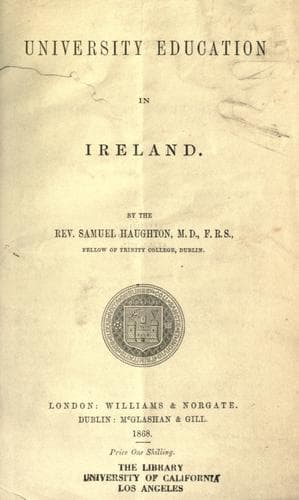
UNIVERSITY EDUCATION
IN
IRELAND.
BY THE
REV. SAMUEL HAUGHTON, M.D, F.R.S.,
FELLOW OF TRINITY COLLEGE, DUBLIN.
LONDON: WILLIAMS & NORGATE.
DUBLIN: McGLASHAN & GILL.
1868.
_Price One Shilling._
DUBLIN:
Printed at the University Press,
BY M. H. GILL.
UNIVERSITY EDUCATION IN IRELAND.
INTRODUCTION.
The political condition of Ireland is, at present, grave; and, in the event
of a war with the United States, would become menacing, to England.
Irish politicians assert--and it is partly admitted by their
opponents--that, in the existing state of Ireland, three questions demand
an immediate solution: these questions are, the Land Question, the Church
Question, and the Education Question.
The tenant farmers of Ireland wish for fixity of tenure, and care but
little for compensation for improvements, except as a means of obtaining a
practical fixity of tenure; and they would, unquestionably, rejoice to see
transferred to themselves, as occupiers of the soil, the rights now enjoyed
by absentee noblemen and landlords. It is the opinion of many that the
Land question cannot be settled without such a change of owners as would
practically amount to a revolution.
With respect to the question of the Church, the more intelligent laymen of
the Irish National party openly avow their wish to alienate the property of
the Church, on the ground that its existence forms a barrier to the union
of Irish Protestants with the Catholic majority in the formation of a truly
National Irish party. It is asserted, and apparently not without reason,
that if the Irish Protestants felt themselves cast off by England, and
their Church endowments confiscated, they might become more willing to join
their countrymen in an anti-English policy, which the rude breath of war
might some day fan into a demand for an Irish Republic, under the guarantee
of France and America. It is for English politicians to decide how far the
advantages of religious equality would compensate for the risk of national
disloyalty.
Public-domain text, read in full here on John Shaqi.
Reviews
Reviews
No reviews yet
Be the first to share your thoughts on this work.
Join the Discussion
Join the discussion
Sign in to leave a comment or review.
Sign InorCreate an account