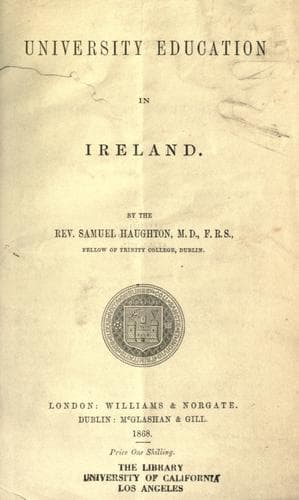
Church and college -- Ireland; Education, Higher -- Ireland; Universities and colleges -- Ireland
We possess in Ireland three distinct types of Collegiate education, of
which may be cited as examples--Trinity College, in Dublin; the Roman
Catholic College of Carlow, and Queen's College, in Belfast. These Colleges
represent, respectively, the religious Protestant type, the Roman Catholic
type, and the secular or mixed type, of Collegiate discipline and training.
Any person of education acquainted with Ireland knows the impossibility of
fusing such distinct elements in a common crucible; and yet each system, in
its way, is excellent, and will produce good fruits, if left to develope
itself, and not forced upon those who conscientiously dissent from its
fundamental principles.
Let us suppose, however, the experiment tried by persons only partially
acquainted with education, and with the condition of Ireland--and by such
only could it be attempted--then it is easy to see that success could be
obtained only at the expense of lowering the standard of education.
It is plain that one or other of two things would happen: either the
University Senate would be composed of persons altogether independent of
the Colleges, and appointed by the State, or it would consist, as in Oxford
and Cambridge, of heads of Colleges and persons representing their varied
interests.
In the first case supposed we should witness the painful and degrading
spectacle of Irish Colleges submitted to the rule of State-appointed,
perhaps, State-paid Governors, who, under the name of an University Senate,
would prescribe the curriculum for degrees, appoint Examiners, and confer
the titles awarded by those Examiners.
It is not possible to suppose that a Senate appointed by an authority
outside the Colleges, and consisting of persons removed from the details of
University Education, would be competent to decide the weighty and
important questions that must come before them; in fact, a Senate
constituted as I have supposed, in discussing questions of education, would
be about as likely to come to a wise decision as a collection of shoemakers
speculating on the structure of a watch, and making proposals for its
improvement, who will certainly destroy the delicate machinery they are
unable to understand, unless they have the sagacity to call in the
watchmakers to their aid.
It might be imagined that the standard of education could be maintained by
such a system, on the hypothesis that a State-nominated Senate would always
appoint competent Examiners; but in such a case those Examiners would
themselves become the University, and would regulate the value of the
degrees conferred by it, and the country could have no guarantee that the
standard of education would continue to be maintained; for this would be to
suppose, on the part of successive Governments, a purity in their
appointment of Senators which no rational man expects will ever be found
outside the boundaries of the kingdom of Laputa.
Public-domain text, read in full here on John Shaqi.
Reviews
Reviews
No reviews yet
Be the first to share your thoughts on this work.
Join the Discussion
Join the discussion
Sign in to leave a comment or review.
Sign InorCreate an account