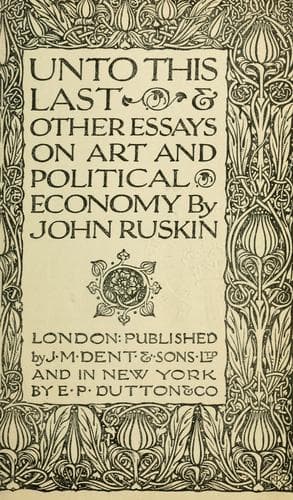
Unto This Last, and Other Essays on Political EconomyRuskin, John
General
Unto This Last, and Other Essays on Political Economy
Ruskin, John
Art; Economics
Although, however, I find nothing to modify in these papers, it is a
matter of regret to me that the most startling of all the statements
in them--that respecting the necessity of the organization of labour,
with fixed wages,--should have found its way into the first essay; it
being quite one of the least important, though by no means the least
certain, of the positions to be defended. The real gist of these
papers, their central meaning and aim, is to give, as I believe for
the first time in plain English--it has often been incidentally given
in good Greek by Plato and Xenophon, and good Latin by Cicero and
Horace,--a logical definition of WEALTH: such definition being
absolutely needed for a basis of economical science. The most reputed
essay on that subject which has appeared in modern times, after
opening with the statement that "writers on political economy
profess to teach, or to investigate,[25] the nature of wealth," thus
follows up the declaration of its thesis--"Every one has a notion,
sufficiently correct for common purposes, of what is meant by
wealth." ... "It is no part of the design of this treatise to aim
at metaphysical nicety of definition."[26]
[25] Which? for where investigation is necessary, teaching is
impossible.
[26] "Principles of Political Economy." By J. S. Mill.
Preliminary remarks, p. 2.
Metaphysical nicety, we assuredly do not need; but physical nicety,
and logical accuracy, with respect to a physical subject, we as
assuredly do.
Suppose the subject of inquiry, instead of being House-law
(_Oikonomia_), had been Star-law (_Astronomia_), and that, ignoring
distinction between stars fixed and wandering, as here between wealth
radiant and wealth reflective, the writer had begun thus: "Every one
has a notion, sufficiently correct for common purposes, of what is
meant by stars. Metaphysical nicety in the definition of a star is not
the object of this treatise;"--the essay so opened might yet have been
far more true in its final statements, and a thousand-fold more
serviceable to the navigator, than any treatise on wealth, which
founds its conclusions on the popular conception of wealth, can ever
become to the economist.
* * * * *
It was, therefore, the first object of these following papers to give
an accurate and stable definition of wealth. Their second object was
to show that the acquisition of wealth was finally possible only under
certain moral conditions of society, of which quite the first was a
belief in the existence and even, for practical purposes, in the
attainability of honesty.
Public-domain text, read in full here on John Shaqi.
Reviews
Reviews
No reviews yet
Be the first to share your thoughts on this work.
Elsewhere in the archive
Join the Discussion
Join the discussion
Sign in to leave a comment or review.
Sign InorCreate an account