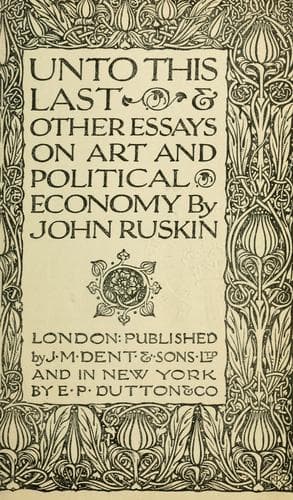
Unto This Last, and Other Essays on Political EconomyRuskin, John
General
Unto This Last, and Other Essays on Political Economy
Ruskin, John
Art; Economics
Without venturing to pronounce--since on such a matter human judgment
is by no means conclusive--what is, or is not, the noblest of God's
works, we may yet admit so much of Pope's assertion as that an honest
man is among His best works presently visible, and, as things stand, a
somewhat rare one; but not an incredible or miraculous work; still
less an abnormal one. Honesty is not a disturbing force, which
deranges the orbits of economy; but a consistent and commanding force,
by obedience to which--and by no other obedience--those orbits can
continue clear of chaos.
It is true, I have sometimes heard Pope condemned for the lowness,
instead of the height, of his standard:--"Honesty is indeed a
respectable virtue; but how much higher may men attain! Shall nothing
more be asked of us than that we be honest?"
For the present, good friends, nothing. It seems that in our
aspirations to be more than that, we have to some extent lost sight of
the propriety of being so much as that. What else we may have lost
faith in, there shall be here no question; but assuredly we have lost
faith in common honesty, and in the working power of it. And this
faith, with the facts on which it may rest, it is quite our first
business to recover and keep: not only believing, but even by
experience assuring ourselves, that there are yet in the world men who
can be restrained from fraud otherwise than by the fear of losing
employment;[27] nay that it is even accurately in proportion to the
number of such men in any State, that the said State does or can
prolong its existence.
[27] "The effectual discipline which is exercised over a workman
is not that of his corporation, but of his customers. It is
the fear of losing their employment which restrains his
frauds, and corrects his negligence" (_Wealth of Nations_,
Book I. chap. 10).
To these two points, then, the following essays are mainly directed.
The subject of the organization of labour is only casually touched
upon; because, if we once can get a sufficient quantity of honesty in
our captains, the organization of labour is easy, and will develop
itself without quarrel or difficulty; but if we cannot get honesty in
our captains, the organization of labour is for evermore impossible.
The several conditions of its possibility I purpose to examine at
length in the sequel. Yet, lest the reader should be alarmed by the
hints thrown out during the following investigation of first
principles, as if they were leading him into unexpectedly dangerous
ground, I will, for his better assurance, state at once the worst of
the political creed at which I wish him to arrive.
Public-domain text, read in full here on John Shaqi.
Reviews
Reviews
No reviews yet
Be the first to share your thoughts on this work.
Elsewhere in the archive
Join the Discussion
Join the discussion
Sign in to leave a comment or review.
Sign InorCreate an account