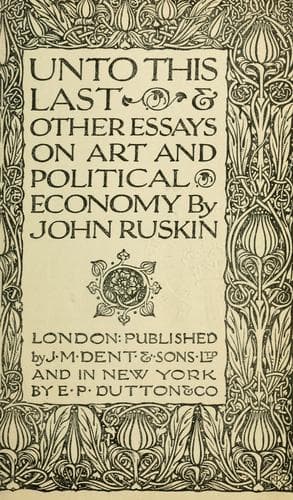
Unto This Last, and Other Essays on Political EconomyRuskin, John
General
Unto This Last, and Other Essays on Political Economy
Ruskin, John
Art; Economics
4. Lastly,--that for the old and destitute, comfort and home should be
provided; which provision, when misfortune had been by the working of
such a system sifted from guilt, would be honourable instead of
disgraceful to the receiver. For (I repeat this passage out of my
_Political Economy of Art_, to which the reader is referred for
farther detail[29]) "a labourer serves his country with his spade,
just as a man in the middle ranks of life serves it with sword, pen,
or lancet: if the service is less, and, therefore the wages during
health less, then the reward, when health is broken, may be less, but
not, therefore, less honourable; and it ought to be quite as natural
and straightforward a matter for a labourer to take his pension from
his parish, because he has deserved well of his parish, as for a man
in higher rank to take his pension from his country, because he has
deserved well of his country."
[29] "The Political Economy of Art:" Addenda, p. 93.
To which statement, I will only add, for conclusion, respecting the
discipline and pay of life and death, that, for both high and low,
Livy's last words touching Valerius Publicola, "_de publico est
elatus_,"[30] ought not to be a dishonourable close of epitaph.
[30] "P. Valerius, omnium consensu princeps belli pacisque
artibus, anno post moritur; gloria ingenti, copiis
familiaribus adeo exiguis, ut funeri sumtus deesset: de
publico est elatus. Luxere matronae ut Brutum."--Lib. II.
c. xvi.
These things, then, I believe, and am about, as I find power, to
explain and illustrate in their various bearings; following out also
what belongs to them of collateral inquiry. Here I state them only in
brief, to prevent the reader casting about in alarm for my ultimate
meaning; yet requesting him, for the present to remember, that in a
science dealing with so subtle elements as those of human nature, it
is only possible to answer for the final truth of principles, not for
the direct success of plans: and that in the best of these last, what
can be immediately accomplished is always questionable, and what can
be finally accomplished, inconceivable.
_Denmark Hill, 10th May, 1862._
ESSAY I.
THE ROOTS OF HONOUR.
Among the delusions which at different periods have possessed
themselves of the minds of large masses of the human race, perhaps
the most curious--certainly the least creditable--is the modern
_soi-disant_ science of political economy, based on the idea that an
advantageous code of social action may be determined irrespectively of
the influence of social affection.
Public-domain text, read in full here on John Shaqi.
Reviews
Reviews
No reviews yet
Be the first to share your thoughts on this work.
Elsewhere in the archive
Join the Discussion
Join the discussion
Sign in to leave a comment or review.
Sign InorCreate an account