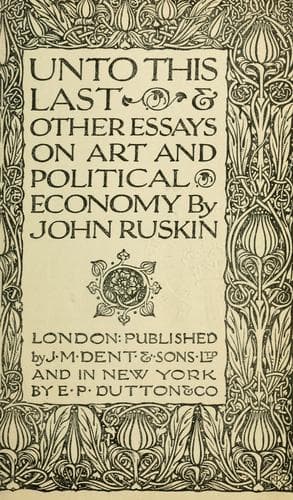
Unto This Last, and Other Essays on Political EconomyRuskin, John
General
Unto This Last, and Other Essays on Political Economy
Ruskin, John
Art; Economics
Of course, as in the instances of alchemy, astrology, witchcraft, and
other such popular creeds, political economy has a plausible idea at
the root of it. "The social affections," says the economist, "are
accidental and disturbing elements in human nature; but avarice and
the desire of progress are constant elements. Let us eliminate the
inconstants, and, considering the human being merely as a covetous
machine, examine by what laws of labour, purchase, and sale, the
greatest accumulative result in wealth is obtainable. Those laws once
determined, it will be for each individual afterwards to introduce as
much of the disturbing affectionate element as he chooses, and to
determine for himself the result on the new conditions supposed."
This would be a perfectly logical and successful method of analysis,
if the accidentals afterwards to be introduced were of the same nature
as the powers first examined. Supposing a body in motion to be
influenced by constant and inconstant forces, it is usually the
simplest way of examining its course to trace it first under the
persistent conditions, and afterwards introduce the causes of
variation. But the disturbing elements in the social problem are not
of the same nature as the constant ones; they alter the essence of
the creature under examination the moment they are added; they
operate, not mathematically, but chemically, introducing conditions
which render all our previous knowledge unavailable. We made learned
experiments upon pure nitrogen, and have convinced ourselves that it
is a very manageable gas: but behold! the thing which we have
practically to deal with is its chloride; and this, the moment we
touch it on our established principles, sends us and our apparatus
through the ceiling.
Observe, I neither impugn nor doubt the conclusions of the science, if
its terms are accepted. I am simply uninterested in them, as I should
be in those of a science of gymnastics which assumed that men had no
skeletons. It might be shown, on that supposition, that it would be
advantageous to roll the students up into pellets, flatten them into
cakes, or stretch them into cables; and that when these results were
effected, the re-insertion of the skeleton would be attended with
various inconveniences to their constitution. The reasoning might be
admirable, the conclusions true, and the science deficient only in
applicability. Modern political economy stands on a precisely similar
basis. Assuming, not that the human being has no skeleton, but that it
is all skeleton, it founds an ossifiant theory of progress on this
negation of a soul; and having shown the utmost that may be made of
bones, and constructed a number of interesting geometrical figures
with death's-heads and humeri, successfully proves the inconvenience
of the reappearance of a soul among these corpuscular structures. I do
not deny the truth of this theory: I simply deny its applicability to
the present phase of the world.
Public-domain text, read in full here on John Shaqi.
Reviews
Reviews
No reviews yet
Be the first to share your thoughts on this work.
Elsewhere in the archive
Join the Discussion
Join the discussion
Sign in to leave a comment or review.
Sign InorCreate an account