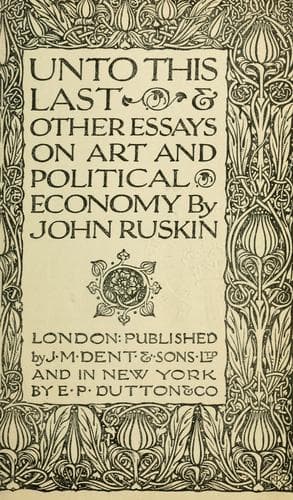
Unto This Last, and Other Essays on Political EconomyRuskin, John
General
Unto This Last, and Other Essays on Political Economy
Ruskin, John
Art; Economics
"It is indeed true that certain advantages of a general nature may be
obtained by the development of social affections. But political
economists never professed, nor profess, to take advantages of a
general nature into consideration. Our science is simply the science
of getting rich. So far from being a fallacious or visionary one, it
is found by experience to be practically effective. Persons who follow
its precepts do actually become rich, and persons who disobey them
become poor. Every capitalist of Europe has acquired his fortune by
following the known laws of our science, and increases his capital
daily by an adherence to them. It is vain to bring forward tricks of
logic, against the force of accomplished facts. Every man of business
knows by experience how money is made, and how it is lost."
Pardon me. Men of business do indeed know how they themselves made
their money, or how, on occasion, they lost it. Playing a
long-practised game, they are familiar with the chances of its cards,
and can rightly explain their losses and gains. But they neither know
who keeps the bank of the gambling-house, nor what other games may be
played with the same cards, nor what other losses and gains, far away
among the dark streets, are essentially, though invisibly, dependent
on theirs in the lighted rooms. They have learned a few, and only a
few, of the laws of mercantile economy; but not one of those of
political economy.
Primarily, which is very notable and curious, I observe that men of
business rarely know the meaning of the word "rich." At least if they
know, they do not in their reasonings allow for the fact that it is a
relative word, implying its opposite "poor" as positively as the word
"north" implies its opposite "south." Men nearly always speak and
write as if riches were absolute, and it were possible, by following
certain scientific precepts, for everybody to be rich. Whereas riches
are a power like that of electricity, acting only through inequalities
or negations of itself. The force of the guinea you have in your
pocket depends wholly on the default of a guinea in your neighbour's
pocket. If he did not want it, it would be of no use to you; the
degree of power it possesses depends accurately upon the need or
desire he has for it,--and the art of making yourself rich, in the
ordinary mercantile economist's sense, is therefore equally and
necessarily the art of keeping your neighbour poor.
I would not contend in this matter (and rarely in any matter), for the
acceptance of terms. But I wish the reader clearly and deeply to
understand the difference between the two economies, to which the
terms "Political" and "Mercantile" might not unadvisably be attached.
Public-domain text, read in full here on John Shaqi.
Reviews
Reviews
No reviews yet
Be the first to share your thoughts on this work.
Elsewhere in the archive
Join the Discussion
Join the discussion
Sign in to leave a comment or review.
Sign InorCreate an account