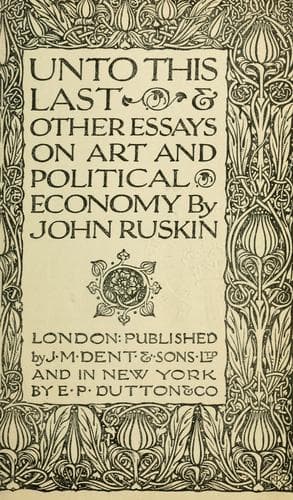
Unto This Last, and Other Essays on Political EconomyRuskin, John
General
Unto This Last, and Other Essays on Political Economy
Ruskin, John
Art; Economics
Again: in his office as governor of the men employed by him, the
merchant or manufacturer is invested with a distinctly paternal
authority and responsibility. In most cases, a youth entering a
commercial establishment is withdrawn altogether from home influence;
his master must become his father, else he has, for practical and
constant help, no father at hand: in all cases the master's authority,
together with the general tone and atmosphere of his business, and the
character of the men with whom the youth is compelled in the course of
it to associate, have more immediate and pressing weight than the home
influence, and will usually neutralize it either for good or evil; so
that the only means which the master has of doing justice to the men
employed by him is to ask himself sternly whether he is dealing with
such subordinate as he would with his own son, if compelled by
circumstances to take such a position.
Supposing the captain of a frigate saw it right, or were by any chance
obliged, to place his own son in the position of a common sailor; as
he would then treat his son, he is bound always to treat every one of
the men under him. So, also; supposing the master of a manufactory
saw it right, or were by any chance obliged, to place his own son in
the position of an ordinary workman; as he would then treat his son,
he is bound always to treat every one of his men. This is the only
effective true, or practical RULE which can be given on this point of
political economy.
And as the captain of a ship is bound to be the last man to leave his
ship in case of wreck, and to share his last crust with the sailors in
case of famine, so the manufacturer, in any commercial crisis or
distress, is bound to take the suffering of it with his men, and even
to take more of it for himself than he allows his men to feel; as a
father would in a famine, shipwreck, or battle, sacrifice himself for
his son.
All which sounds very strange: the only real strangeness in the matter
being, nevertheless, that it should so sound. For all this is true,
and that not partially nor theoretically, but everlastingly and
practically: all other doctrine than this respecting matters political
being false in premises, absurd in deduction, and impossible in
practice, consistently with any progressive state of national life;
all the life which we now possess as a nation showing itself in the
resolute denial and scorn, by a few strong minds and faithful hearts,
of the economic principles taught to our multitudes, which principles,
so far as accepted, lead straight to national destruction. Respecting
the modes and forms of destruction to which they lead, and, on the
other hand, respecting the farther practical working of true polity,
I hope to reason further in a following paper.
ESSAY II.
THE VEINS OF WEALTH.
The answer which would be made by any ordinary political economist to
the statements contained in the preceding paper, is in few words as
follows:--
Public-domain text, read in full here on John Shaqi.
Reviews
Reviews
No reviews yet
Be the first to share your thoughts on this work.
Elsewhere in the archive
Join the Discussion
Join the discussion
Sign in to leave a comment or review.
Sign InorCreate an account