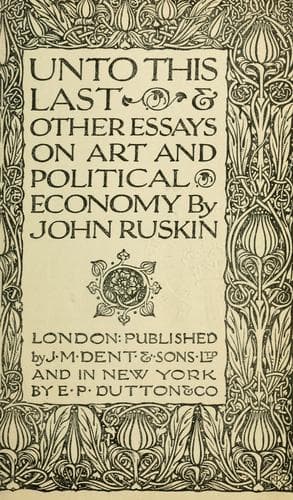
Unto This Last, and Other Essays on Political EconomyRuskin, John
General
Unto This Last, and Other Essays on Political Economy
Ruskin, John
Art; Economics
There is, however, another reason for this habit of mind; namely, that
an accumulation of real property is of little use to its owner,
unless, together with it, he has commercial power over labour. Thus,
suppose any person to be put in possession of a large estate of
fruitful land, with rich beds of gold in its gravel, countless herds
of cattle in its pastures; houses, and gardens, and storehouses full
of useful stores; but suppose, after all, that he could get no
servants? In order that he may be able to have servants, some one in
his neighbourhood must be poor, and in want of his gold--or his corn.
Assume that no one is in want of either, and that no servants are to
be had. He must, therefore, bake his own bread, make his own clothes,
plough his own ground, and shepherd his own flocks. His gold will be
as useful to him as any other yellow pebbles on his estate. His stores
must rot, for he cannot consume them. He can eat no more than another
man could eat, and wear no more than another man could wear. He must
lead a life of severe and common labour to procure even ordinary
comforts; he will be ultimately unable to keep either houses in
repair, or fields in cultivation; and forced to content himself with a
poor man's portion of cottage and garden, in the midst of a desert of
waste land, trampled by wild cattle, and encumbered by ruins of
palaces, which he will hardly mock at himself by calling "his own."
The most covetous of mankind would, with small exultation, I presume,
accept riches of this kind on these terms. What is really desired,
under the name of riches, is, essentially, power over men; in its
simplest sense, the power of obtaining for our own advantage the
labour of servant, tradesman, and artist; in wider sense, authority
of directing large masses of the nation to various ends (good,
trivial, or hurtful, according to the mind of the rich person). And
this power of wealth of course is greater or less in direct proportion
to the poverty of the men over whom it is exercised, and in inverse
proportion to the number of persons who are as rich as ourselves, and
who are ready to give the same price for an article of which the
supply is limited. If the musician is poor, he will sing for small
pay, as long as there is only one person who can pay him; but if there
be two or three, he will sing for the one who offers him most. And
thus the power of the riches of the patron (always imperfect and
doubtful, as we shall see presently, even when most authoritative)
depends first on the poverty of the artist, and then on the limitation
of the number of equally wealthy persons, who also wants seats at the
concert. So that, as above stated, the art of becoming "rich," in the
common sense, is not absolutely nor finally the art of accumulating
much money for ourselves, but also of contriving that our neighbours
shall have less. In accurate terms, it is "the art of establishing the
maximum inequality in our own favour."
Public-domain text, read in full here on John Shaqi.
Reviews
Reviews
No reviews yet
Be the first to share your thoughts on this work.
Elsewhere in the archive
Join the Discussion
Join the discussion
Sign in to leave a comment or review.
Sign InorCreate an account