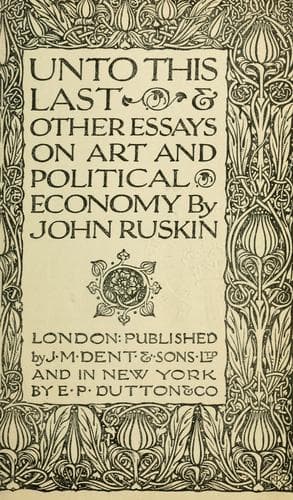
Unto This Last, and Other Essays on Political EconomyRuskin, John
General
Unto This Last, and Other Essays on Political Economy
Ruskin, John
Art; Economics
Now the establishment of such inequality cannot be shown in the
abstract to be either advantageous or disadvantageous to the body of
the nation. The rash and absurd assumption that such inequalities are
necessarily advantageous, lies at the root of most of the popular
fallacies on the subject of political economy. For the eternal and
inevitable law in this matter is, that the beneficialness of the
inequality depends, first, on the methods by which it was
accomplished, and, secondly, on the purposes to which it is applied.
Inequalities of wealth, unjustly established, have assuredly injured
the nation in which they exist during their establishment; and,
unjustly directed, injure it yet more during their existence. But
inequalities of wealth justly established, benefit the nation in the
course of their establishment; and, nobly used, aid it yet more by
their existence. That is to say, among every active and well-governed
people, the various strength of individuals, tested by full exertion
and specially applied to various need, issues in unequal, but
harmonious results, receiving reward or authority according to its
class and service;[32] while, in the inactive or ill-governed nation,
the gradations of decay and the victories of treason work out also
their own rugged system of subjection and success; and substitute, for
the melodious inequalities of concurrent power, the iniquitous
dominances and depressions of guilt and misfortune.
[32] I have been naturally asked several times, with respect
to the sentence in the first of these papers, "the bad
workmen unemployed," "But what are you to do with your bad
unemployed workmen?" Well, it seems to me the question might
have occurred to you before. Your housemaid's place is
vacant--you give twenty pounds a year--two girls come for
it, one neatly dressed, the other dirtily; one with good
recommendations, the other with none. You do not, under
these circumstances, usually ask the dirty one if she will
come for fifteen pounds, or twelve; and, on her consenting,
take her instead of the well-recommended one. Still less do
you try to beat both down by making them bid against each
other, till you can hire both, one at twelve pounds a year,
and the other at eight. You simply take the one fittest for
the place, and send away the other, not perhaps concerning
yourself quite as much as you should with the question which
you now impatiently put to me, "What is to become of her?"
For all that I advise you to do, is to deal with workmen as
with servants; and verily the question is of weight: "Your
bad workman, idler, and rogue--what are you to do with him?"
Public-domain text, read in full here on John Shaqi.
Reviews
Reviews
No reviews yet
Be the first to share your thoughts on this work.
Elsewhere in the archive
Join the Discussion
Join the discussion
Sign in to leave a comment or review.
Sign InorCreate an account