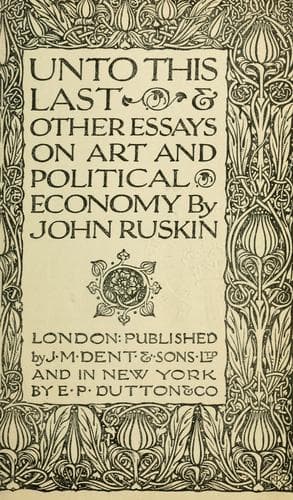
Unto This Last, and Other Essays on Political EconomyRuskin, John
General
Unto This Last, and Other Essays on Political Economy
Ruskin, John
Art; Economics
We will consider of this presently: remember that the
administration of a complete system of national commerce and
industry cannot be explained in full detail within the space
of twelve pages. Meantime, consider whether, there being
confessedly some difficulty in dealing with rogues and
idlers, it may not be advisable to produce as few of them as
possible. If you examine into the history of rogues, you
will find they are as truly manufactured articles as
anything else, and it is just because our present system of
political economy gives so large a stimulus to that
manufacture that you may know it to be a false one. We had
better seek for a system which will develop honest men, than
for one which will deal cunningly with vagabonds. Let us
reform our schools, and we shall find little reform needed
in our prisons.
Thus the circulation of wealth in a nation resembles that of the blood
in the natural body. There is one quickness of the current which comes
of cheerful emotion or wholesome exercise; and another which comes of
shame or of fever. There is a flush of the body which is full of
warmth and life; and another which will pass into putrefaction.
The analogy will hold, down even to minute particulars. For as
diseased local determination of the blood involves depression of the
general health of the system, all morbid local action of riches will
be found ultimately to involve a weakening of the resources of the
body politic.
The mode in which this is produced may be at once understood by
examining one or two instances of the development of wealth in the
simplest possible circumstances.
Suppose two sailors cast away on an uninhabited coast, and obliged to
maintain themselves there by their own labour for a series of years.
If they both kept their health, and worked steadily, and in amity with
each other, they might build themselves a convenient house, and in
time come to possess a certain quantity of cultivated land, together
with various stores laid up for future use. All these things would be
real riches or property; and, supposing the men both to have worked
equally hard, they would each have right to equal share or use of it.
Their political economy would consist merely in careful preservation
and just division of these possessions. Perhaps, however, after some
time one or other might be dissatisfied with the results of their
common farming; and they might in consequence agree to divide the land
they had brought under the spade into equal shares, so that each might
thenceforward work in his own field and live by it. Suppose that after
this arrangement had been made, one of them were to fall ill, and be
unable to work on his land at a critical time--say of sowing or
harvest.
He would naturally ask the other to sow or reap for him.
Public-domain text, read in full here on John Shaqi.
Reviews
Reviews
No reviews yet
Be the first to share your thoughts on this work.
Elsewhere in the archive
Join the Discussion
Join the discussion
Sign in to leave a comment or review.
Sign InorCreate an account