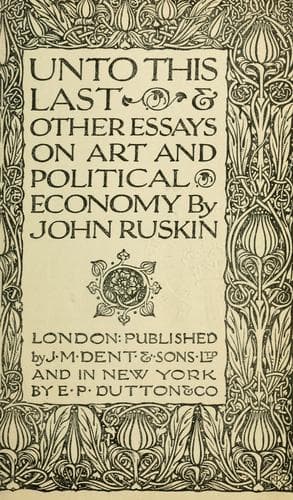
Unto This Last, and Other Essays on Political EconomyRuskin, John
General
Unto This Last, and Other Essays on Political Economy
Ruskin, John
Art; Economics
Take another example, more consistent with the ordinary course of
affairs of trade. Suppose that three men, instead of two, formed the
little isolated republic, and found themselves obliged to separate in
order to farm different pieces of land at some distance from each
other along the coast; each estate furnishing a distinct kind of
produce, and each more or less in need of the material raised on the
other. Suppose that the third man, in order to save the time of all
three, undertakes simply to superintend the transference of
commodities from one farm to the other; on condition of receiving some
sufficiently remunerative share of every parcel of goods conveyed, or
of some other parcel received in exchange for it.
If this carrier or messenger always brings to each estate, from the
other, what is chiefly wanted, at the right time, the operations of
the two farmers will go on prosperously, and the largest possible
result in produce, or wealth, will be attained by the little
community. But suppose no intercourse between the landowners is
possible, except through the travelling agent; and that, after a time,
this agent, watching the course of each man's agriculture, keeps back
the articles with which he has been entrusted until there comes a
period of extreme necessity for them, on one side or other, and then
exacts in exchange for them all that the distressed farmer can spare
of other kinds of produce; it is easy to see that by ingeniously
watching his opportunities, he might possess himself regularly of the
greater part of the superfluous produce of the two estates, and at
last, in some year of severest trial or scarcity, purchase both for
himself, and maintain the former proprietors thenceforward as his
labourers or servants.
This would be a case of commercial wealth acquired on the exactest
principles of modern political economy. But more distinctly even than
in the former instance, it is manifest in this that the wealth of the
State, or of the three men considered as a society, is collectively
less than it would have been had the merchant been content with juster
profit. The operations of the two agriculturists have been cramped to
the utmost; and the continual limitations of the supply of things they
wanted at critical times, together with the failure of courage
consequent on the prolongation of a struggle for mere existence,
without any sense of permanent gain, must have seriously diminished
the effective results of their labour; and the stores finally
accumulated in the merchant's hands will not in anywise be of
equivalent value to those which, had his dealings been honest, would
have filled at once the granaries of the farmers and his own.
Public-domain text, read in full here on John Shaqi.
Reviews
Reviews
No reviews yet
Be the first to share your thoughts on this work.
Elsewhere in the archive
Join the Discussion
Join the discussion
Sign in to leave a comment or review.
Sign InorCreate an account