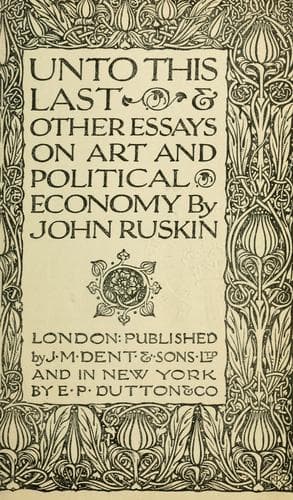
Unto This Last, and Other Essays on Political EconomyRuskin, John
General
Unto This Last, and Other Essays on Political Economy
Ruskin, John
Art; Economics
The whole question, therefore, respecting not only the advantage, but
even the quantity, of national wealth, resolves itself finally into
one of abstract justice. It is impossible to conclude, of any given
mass of acquired wealth, merely by the fact of its existence, whether
it signifies good or evil to the nation in the midst of which it
exists. Its real value depends on the moral sign attached to it, just
as sternly as that of a mathematical quantity depends on the
algebraical sign attached to it. Any given accumulation of commercial
wealth may be indicative, on the one hand, of faithful industries,
progressive energies, and productive ingenuities; or, on the other, it
may be indicative of mortal luxury, merciless tyranny, ruinous
chicane. Some treasures are heavy with human tears, as an ill-stored
harvest with untimely rain; and some gold is brighter in sunshine than
it is in substance.
And these are not, observe, merely moral or pathetic attributes of
riches, which the seeker of riches may, if he chooses, despise; they
are, literally and sternly, material attributes of riches,
depreciating or exalting, incalculably, the monetary signification of
the sum in question. One mass of money is the outcome of action which
has created,--another, of action which has annihilated,--ten times as
much in the gathering of it; such and such strong hands have been
paralysed, as if they had been numbed by nightshade: so many strong
men's courage broken, so many productive operations hindered; this and
the other false direction given to labour, and lying image of
prosperity set up, on Dura plains dug into seven-times-heated
furnaces. That which seems to be wealth may in verity be only the
gilded index of far-reaching ruin; a wrecker's handful of coin gleaned
from the beach to which he has beguiled an argosy; a camp-follower's
bundle of rags unwrapped from the breasts of goodly soldiers dead; the
purchase-pieces of potter's fields, wherein shall be buried together
the citizen and the stranger.
Public-domain text, read in full here on John Shaqi.
Reviews
Reviews
No reviews yet
Be the first to share your thoughts on this work.
Elsewhere in the archive
Join the Discussion
Join the discussion
Sign in to leave a comment or review.
Sign InorCreate an account