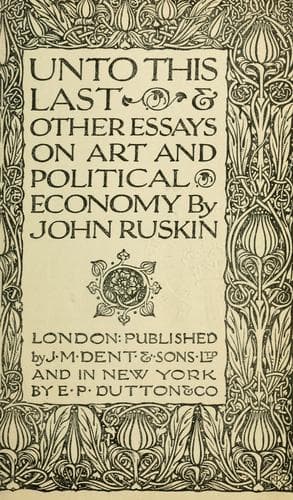
Unto This Last, and Other Essays on Political EconomyRuskin, John
General
Unto This Last, and Other Essays on Political Economy
Ruskin, John
Art; Economics
Some centuries before the Christian era, a Jew merchant, largely
engaged in business on the Gold Coast, and reported to have made one
of the largest fortunes of his time (held also in repute for much
practical sagacity), left among his ledgers some general maxims
concerning wealth, which have been preserved, strangely enough, even
to our own days. They were held in considerable respect by the most
active traders of the middle ages, especially by the Venetians, who
even went so far in their admiration as to place a statue of the old
Jew on the angle of one of their principal public buildings. Of late
years these writings have fallen into disrepute, being opposed in
every particular to the spirit of modern commerce. Nevertheless, I
shall reproduce a passage or two from them here, partly because they
may interest the reader by their novelty; and chiefly because they
will show him that it is possible for a very practical and acquisitive
tradesman to hold, through a not unsuccessful career, that principle
of distinction between well-gotten and ill-gotten wealth, which,
partially insisted on in my last paper, it must be our work more
completely to examine in this.
He says, for instance, in one place: "The getting of treasures by a
lying tongue is a vanity tossed to and fro of them that seek death:"
adding in another, with the same meaning (he has a curious way of
doubling his sayings): "Treasures of wickedness profit nothing: but
justice delivers from death." Both these passages are notable for
their assertion of death as the only real issue and sum of attainment
by any unjust scheme of wealth. If we read, instead of "lying
tongue," "lying label, title, pretence, or advertisement," we shall
more clearly perceive the bearing of the words on modern business. The
seeking of death is a grand expression of the true course of men's
toil in such business. We usually speak as if death pursued us, and we
fled from him; but that is only so in rare instances. Ordinarily, he
masks himself--makes himself beautiful--all-glorious; not like the
King's daughter, all-glorious within, but outwardly: his clothing of
wrought gold. We pursue him frantically all our days, he flying or
hiding from us. Our crowning success at three-score and ten is utterly
and perfectly to seize, and hold him in his eternal integrity---robes,
ashes, and sting.
Again: the merchant says, "He that oppresseth the poor to increase his
riches, shall surely come to want." And again, more strongly: "Rob not
the poor because he is poor; neither oppress the afflicted in the
place of business. For God shall spoil the soul of those that spoiled
them."
Public-domain text, read in full here on John Shaqi.
Reviews
Reviews
No reviews yet
Be the first to share your thoughts on this work.
Elsewhere in the archive
Join the Discussion
Join the discussion
Sign in to leave a comment or review.
Sign InorCreate an account