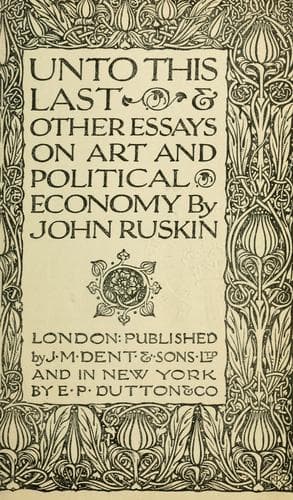
Unto This Last, and Other Essays on Political EconomyRuskin, John
General
Unto This Last, and Other Essays on Political Economy
Ruskin, John
Art; Economics
But farther. Since the essence of wealth consists in its authority
over men, if the apparent or nominal wealth fail in this power, it
fails in essence; in fact, ceases to be wealth at all. It does not
appear lately in England, that our authority over men is absolute. The
servants show some disposition to rush riotously upstairs, under an
impression that their wages are not regularly paid. We should augur
ill of any gentleman's property to whom this happened every other day
in his drawing-room.
So also, the power of our wealth seems limited as respects the comfort
of the servants, no less than their quietude. The persons in the
kitchen appear to be ill-dressed, squalid, half-starved. One cannot
help imagining that the riches of the establishment must be of a very
theoretical and documentary character.
Finally. Since the essence of wealth consists in power over men, will
it not follow that the nobler and the more in number the persons are
over whom it has power, the greater the wealth? Perhaps it may even
appear after some consideration, that the persons themselves _are_ the
wealth--that these pieces of gold with which we are in the habit of
guiding them, are, in fact, nothing more than a kind of Byzantine
harness or trappings, very glittering and beautiful in barbaric sight,
wherewith we bridle the creatures; but that if these same living
creatures could be guided without the fretting and jingling of the
byzants in their mouths and ears, they might themselves be more
valuable than their bridles. In fact, it may be discovered that the
true veins of wealth are purple--and not in Rock, but in
Flesh--perhaps even that the final outcome and consummation of all
wealth is in the producing as many as possible full-breathed,
bright-eyed, and happy-hearted human creatures. Our modern wealth, I
think, has rather a tendency the other way;--most political economists
appearing to consider multitudes of human creatures not conducive to
wealth, or at best conducive to it only by remaining in a dim-eyed and
narrow-chested state of being.
Nevertheless, it is open, I repeat, to serious question, which I leave
to the reader's pondering, whether, among national manufactures, that
of Souls of a good quality may not at last turn out a quite leadingly
lucrative one? Nay, in some faraway and yet undreamt-of hour, I can
even imagine that England may cast all thoughts of possessive wealth
back to the barbaric nations among whom they first arose; and that,
while the sands of the Indus and adamant of Golconda may yet stiffen
the housings of the charger, and flash from the turban of the slave,
she, as a Christian mother, may at last attain to the virtues and the
treasures of a Heathen one, and be able to lead forth her Sons,
saying--
"These are MY Jewels."
ESSAY III.
"QUI JUDICATIS TERRAM."
Public-domain text, read in full here on John Shaqi.
Reviews
Reviews
No reviews yet
Be the first to share your thoughts on this work.
Elsewhere in the archive
Join the Discussion
Join the discussion
Sign in to leave a comment or review.
Sign InorCreate an account