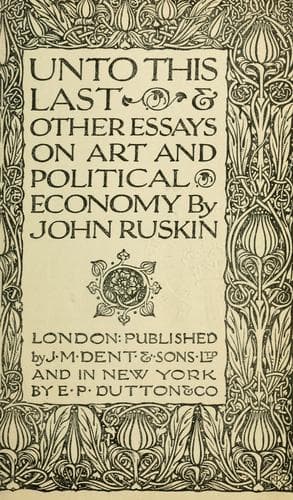
Unto This Last, and Other Essays on Political EconomyRuskin, John
General
Unto This Last, and Other Essays on Political Economy
Ruskin, John
Art; Economics
and deadliest of national plagues: water of Marah--the water which
feeds the roots of all evil.
[36] "Length of days in her right hand; in her left, riches
and honour."
The necessity of these laws of distribution or restraint is curiously
overlooked in the ordinary political economist's definition of his own
"science." He calls it, shortly, the "science of getting rich." But
there are many sciences, as well as many arts, of getting rich.
Poisoning people of large estates was one employed largely in the
middle ages; adulteration of food of people of small estates is one
employed largely now. The ancient and honourable Highland method of
black mail; the more modern and less honourable system of obtaining
goods on credit, and the other variously improved methods of
appropriation--which, in major and minor scales of industry, down to
the most artistic pocket-picking, we owe to recent genius,--all come
under the general head of sciences, or arts, of getting rich.
So that it is clear the popular economist, in calling his science the
science _par excellence_ of getting rich, must attach some peculiar
ideas of limitation to its character. I hope I do not misrepresent
him, by assuming that he means _his_ science to be the science of
"getting rich by legal or just means." In this definition, is the word
"just," or "legal," finally to stand? For it is possible among certain
nations, or under certain rulers, or by help of certain advocates,
that proceedings may be legal which are by no means just. If,
therefore, we leave at last only the word "just" in that place of our
definition, the insertion of this solitary and small word will make a
notable difference in the grammar of our science. For then it will
follow that, in order to grow rich scientifically we must grow rich
justly; and, therefore, know what is just; so that our economy will no
longer depend merely on prudence, but on jurisprudence--and that of
divine, not human law. Which prudence is indeed of no mean order,
holding itself, as it were, high in the air of heaven, and gazing for
ever on the light of the sun of justice; hence the souls which have
excelled in it are represented by Dante as stars forming in heaven for
ever the figure of the eye of an eagle: they having been in life the
discerners of light from darkness; or to the whole human race, as the
light of the body, which is the eye; while those souls which form the
wings of the bird (giving power and dominion to justice, "healing in
its wings") trace also in light the inscription in heaven: "DILIGITE
JUSTITIAM QUI JUDICATIS TERRAM." "Ye who judge the earth, give" (not,
observe, merely love, but) "diligent love to justice:" the love which
seeks diligently, that is to say, choosingly, and by preference to all
things else. Which judging or doing judgment in the earth is,
according to their capacity and position, required not of judges
only, nor of rulers only, but of all men:[37] a truth sorrowfully lost
Public-domain text, read in full here on John Shaqi.
Reviews
Reviews
No reviews yet
Be the first to share your thoughts on this work.
Elsewhere in the archive
Join the Discussion
Join the discussion
Sign in to leave a comment or review.
Sign InorCreate an account