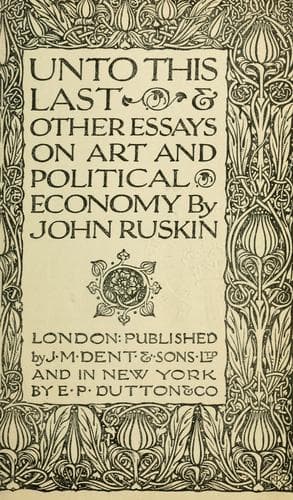
Unto This Last, and Other Essays on Political EconomyRuskin, John
General
Unto This Last, and Other Essays on Political Economy
Ruskin, John
Art; Economics
sight of even by those who are ready enough to apply to themselves
passages in which Christian men are spoken of as called to be "saints"
(_i.e._, to helpful or healing functions); and "chosen to be kings"
(_i.e._, to knowing or directing functions); the true meaning of these
titles having been long lost through the pretences of unhelpful and
unable persons to saintly and kingly character; also through the once
popular idea that both the sanctity and royalty are to consist in
wearing long robes and high crowns, instead of in mercy and judgment;
whereas all true sanctity is saving power, as all true royalty is
ruling power; and injustice is part and parcel of the denial of such
power, which "makes men as the creeping things, as the fishes of the
sea, that have no ruler over them."[38]
[37] I hear that several of our lawyers have been greatly
amused by the statement in the first of these papers that a
lawyer's function was to do justice. I did not intend it for
a jest; nevertheless it will be seen that in the above
passage neither the determination nor doing of justice are
contemplated as functions wholly peculiar to the lawyer.
Possibly, the more our standing armies, whether of soldiers,
pastors, or legislators (the generic term "pastor" including
all teachers, and the generic term "lawyer" including makers
as well as interpreters of law), can be superseded by the
force of national heroism, wisdom, and honesty, the better
it may be for the nation.
[38] It being the privilege of the fishes, as it is of rats and
wolves, to live by the laws of demand and supply; but the
distinction of humanity, to live by those of right.
Absolute justice is indeed no more attainable than absolute truth; but
the righteous man is distinguished from the unrighteous by his desire
and hope of justice, as the true man from the false by his desire and
hope of truth. And though absolute justice be unattainable, as much
justice as we need for all practical use is attainable by all those
who make it their aim.
We have to examine, then, in the subject before us, what are the laws
of justice respecting payment of labour--no small part, these, of the
foundations of all jurisprudence.
I reduced, in my last paper, the idea of money payment to its simplest
or radical terms. In those terms its nature, and the conditions of
justice respecting it, can be best ascertained.
Money payment, as there stated, consists radically in a promise to
some person working for us, that for the time and labour he spends in
our service to-day we will give or procure equivalent time and labour
in his service at any future time when he may demand it.[39]
Public-domain text, read in full here on John Shaqi.
Reviews
Reviews
No reviews yet
Be the first to share your thoughts on this work.
Elsewhere in the archive
Join the Discussion
Join the discussion
Sign in to leave a comment or review.
Sign InorCreate an account