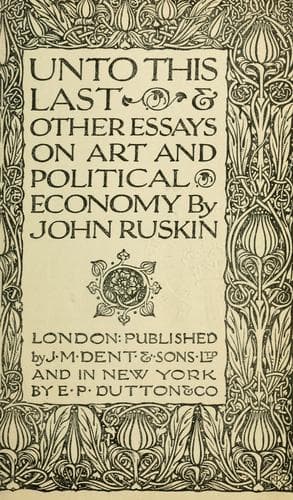
Unto This Last, and Other Essays on Political EconomyRuskin, John
General
Unto This Last, and Other Essays on Political Economy
Ruskin, John
Art; Economics
When we ask a service of any man, he may either give it us freely, or
demand payment for it. Respecting free gift of service, there is no
question at present, that being a matter of affection--not of traffic.
But if he demand payment for it, and we wish to treat him with
absolute equity, it is evident that this equity can only consist in
giving time for time, strength for strength, and skill for skill. If a
man works an hour for us, and we only promise to work half an hour for
him in return, we obtain an unjust advantage. If, on the contrary, we
promise to work an hour and a half for him in return, he has an unjust
advantage. The justice consists in absolute exchange; or, if there be
any respect to the stations of the parties, it will not be in favour
of the employer: there is certainly no equitable reason in a man's
being poor, that if he give me a pound of bread to-day, I should
return him less than a pound of bread to-morrow; or any equitable
reason in a man's being uneducated, that if he uses a certain quantity
of skill and knowledge in my service, I should use a less quantity of
skill and knowledge in his. Perhaps, ultimately, it may appear
desirable, or, to say the least, gracious, that I should give in
return somewhat more than I received. But at present, we are concerned
on the law of justice only, which is that of perfect and accurate
exchange;--one circumstance only interfering with the simplicity of
this radical idea of just payment--that inasmuch as labour (rightly
directed) is fruitful just as seed is, the fruit (or "interest" as it
is called) of the labour first given, or "advanced," ought to be taken
into account, and balanced by an additional quantity of labour in the
subsequent repayment. Supposing the repayment to take place at the end
of a year, or of any other given time, this calculation could be
approximately made; but as money (that is to say, cash) payment
involves no reference to time (it being optional with the person paid
to spend what he receives at once or after any number of years), we
can only assume, generally, that some slight advantage must in equity
be allowed to the person who advances the labour, so that the typical
form of bargain will be: If you give me an hour to-day, I will give
you an hour and five minutes on demand. If you give me a pound of
bread to-day, I will give you seventeen ounces on demand, and so on.
All that is necessary for the reader to note is, that the amount
returned is at least in equity not to be _less_ than the amount given.
Public-domain text, read in full here on John Shaqi.
Reviews
Reviews
No reviews yet
Be the first to share your thoughts on this work.
Elsewhere in the archive
Join the Discussion
Join the discussion
Sign in to leave a comment or review.
Sign InorCreate an account