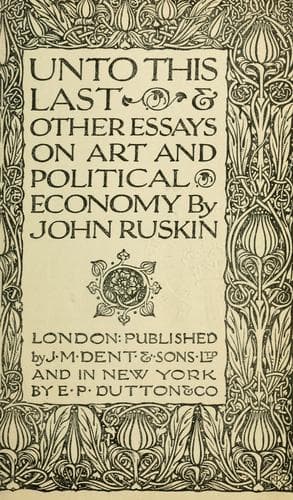
Unto This Last, and Other Essays on Political EconomyRuskin, John
General
Unto This Last, and Other Essays on Political Economy
Ruskin, John
Art; Economics
The abstract idea, then, of just or due wages, as respects the
labourer, is that they will consist in a sum of money which will at
any time procure for him at least as much labour as he has given,
rather more than less. And this equity or justice of payment is,
observe, wholly independent of any reference to the number of men who
are willing to do the work. I want a horseshoe for my horse. Twenty
smiths, or twenty thousand smiths, may be ready to forge it; their
number does not in one atom's weight affect the question of the
equitable payment of the one who _does_ forge it. It costs him a
quarter of an hour of his life, and so much skill and strength of arm
to make that horseshoe for me. Then at some future time I am bound in
equity to give a quarter of an hour, and some minutes more, of my life
(or of some other person's at my disposal), and also as much strength
of arm and skill, and a little more, in making or doing what the smith
may have need of.
Such being the abstract theory of just remunerative payment, its
application is practically modified by the fact that the order for
labour, given in payment, is general, while the labour received is
special. The current coin or document is practically an order on the
nation for so much work of any kind; and this universal applicability
to immediate need renders it so much more valuable than special labour
can be, that an order for a less quantity of this general toil will
always be accepted as a just equivalent for a greater quantity of
special toil. Any given craftsman will always be willing to give an
hour of his own work in order to receive command over half an hour, or
even much less, of national work. This source of uncertainty, together
with the difficulty of determining the monetary value of skill,[40]
renders the ascertainment (even approximate) of the proper wages of
any given labour in terms of currency, matter of considerable
complexity. But they do not affect the principle of exchange. The
worth of the work may not be easily known; but it _has_ a worth, just
as fixed and real as the specific gravity of a substance, though such
specific gravity may not be easily ascertainable when the substance is
united with many others. Nor is there so much difficulty or chance in
determining it as in determining the ordinary maxima and minima of
vulgar political economy. There are few bargains in which the buyer
can ascertain with anything like precision that the seller would have
taken no less;--or the seller acquire more than a comfortable faith
that the purchaser would have given no more. This impossibility of
precise knowledge prevents neither from striving to attain the desired
point of greatest vexation and injury to the other, nor from accepting
it for a scientific principle that he is to buy for the least and sell
for the most possible, though what the real least or most may be he
cannot tell. In like manner, a just person lays it down for a
Public-domain text, read in full here on John Shaqi.
Reviews
Reviews
No reviews yet
Be the first to share your thoughts on this work.
Elsewhere in the archive
Join the Discussion
Join the discussion
Sign in to leave a comment or review.
Sign InorCreate an account