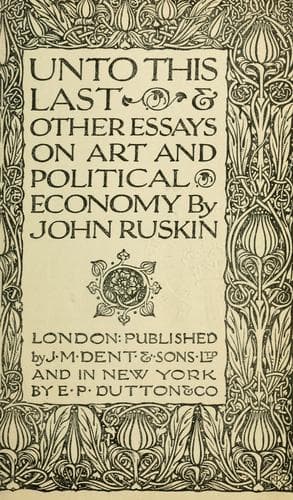
Unto This Last, and Other Essays on Political EconomyRuskin, John
General
Unto This Last, and Other Essays on Political Economy
Ruskin, John
Art; Economics
scientific principle that he is to pay a just price, and, without
being able precisely to ascertain the limits of such a price, will
nevertheless strive to attain the closest possible approximation to
them. A practically serviceable approximation he _can_ obtain. It is
easier to determine scientifically what a man ought to have for his
work, than what his necessities will compel him to take for it. His
necessities can only be ascertained by empirical, but his due by
analytical, investigation. In the one case, you try your answer to the
sum like a puzzled schoolboy--till you find one that fits; in the
other, you bring out your result within certain limits, by process of
calculation.
[40] Under the term "skill" I mean to include the united force of
experience, intellect, and passion in their operation on
manual labour: and under the term "passion," to include the
entire range and agency of the moral feelings; from the
simple patience and gentleness of mind which will give
continuity and fineness to the touch, or enable one person
to work without fatigue, and with good effect, twice as long
as another, up to the qualities of character which render
science possible--(the retardation of science by envy is one
of the most tremendous losses in the economy of the present
century)--and to the incommunicable emotion and imagination
which are the first and mightiest sources of all value in
art.
It is highly singular that political economists should not
yet have perceived, if not the moral, at least the
passionate element, to be an inextricable quantity in every
calculation. I cannot conceive, for instance, how it was
possible that Mr. Mill should have followed the true clue so
far as to write,--"No limit can be set to the
importance--even in a purely productive and material point
of view--of mere thought," without seeing that it was
logically necessary to add also, "and of mere feeling." And
this the more, because in his first definition of labour he
includes in the idea of it "all feelings of a disagreeable
kind connected with the employment of one's thoughts in a
particular occupation." True; but why not also, "feelings of
an agreeable kind?" It can hardly be supposed that the
feelings which retard labour are more essentially a part of
the labour than those which accelerate it. The first are
paid for as pain, the second as power. The workman is merely
indemnified for the first; but the second both produce a
part of the exchangeable value of the work, and materially
increase its actual quantity.
Public-domain text, read in full here on John Shaqi.
Reviews
Reviews
No reviews yet
Be the first to share your thoughts on this work.
Elsewhere in the archive
Join the Discussion
Join the discussion
Sign in to leave a comment or review.
Sign InorCreate an account