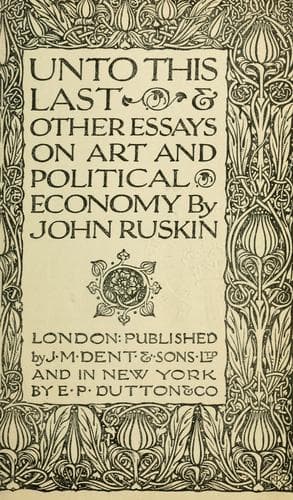
Unto This Last, and Other Essays on Political EconomyRuskin, John
General
Unto This Last, and Other Essays on Political Economy
Ruskin, John
Art; Economics
It is on this vital problem that the entire destiny of the labourer is
ultimately dependent. Many minor interests may sometimes appear to
interfere with it, but all branch from it. For instance, considerable
agitation is often caused in the minds of the lower classes when they
discover the share which they nominally, and to all appearance,
actually, pay out of their wages in taxation (I believe thirty-five or
forty per cent.). This sounds very grievous; but in reality the
labourer does not pay it, but his employer. If the workman had not to
pay it, his wages would be less by just that sum: competition would
still reduce them to the lowest rate at which life was possible.
Similarly the lower orders agitated for the repeal of the corn
laws,[42] thinking they would be better off if bread were cheaper;
never perceiving that as soon as bread was permanently cheaper, wages
would permanently fall in precisely that proportion. The corn laws
were rightly repealed; not, however, because they directly oppressed
the poor, but because they indirectly oppressed them in causing a
large quantity of their labour to be consumed unproductively. So also
unnecessary taxation oppresses them, through destruction of capital,
but the destiny of the poor depends primarily always on this one
question of dueness of wages. Their distress (irrespectively of that
caused by sloth, minor error, or crime) arises on the grand scale from
the two reacting forces of competition and oppression. There is not
yet, nor will yet for ages be, any real over-population in the world;
but a local over-population, or, more accurately, a degree of
population locally unmanageable under existing circumstances for want
of forethought and sufficient machinery, necessarily shows itself by
pressure of competition; and the taking advantage of this competition
by the purchaser to obtain their labour unjustly cheap, consummates at
once their suffering and his own; for in this (as I believe in every
other kind of slavery) the oppressor suffers at last more than the
oppressed, and those magnificent lines of Pope, even in all their
force, fall short of the truth--
"Yet, to be just to these poor men of pelf,
Each does but HATE HIS NEIGHBOUR AS HIMSELF:
Damned to the mines, an equal fate betides
The slave that digs it, and the slave that hides."
Public-domain text, read in full here on John Shaqi.
Reviews
Reviews
No reviews yet
Be the first to share your thoughts on this work.
Elsewhere in the archive
Join the Discussion
Join the discussion
Sign in to leave a comment or review.
Sign InorCreate an account