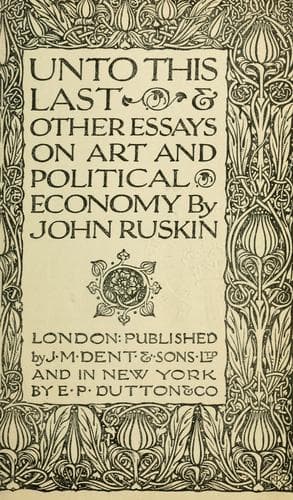
Unto This Last, and Other Essays on Political EconomyRuskin, John
General
Unto This Last, and Other Essays on Political Economy
Ruskin, John
Art; Economics
[42] I have to acknowledge an interesting communication on the
subject of free trade from Paisley (for a short letter from
"A Well-wisher" at ----, my thanks are yet more due). But
the Scottish writer will, I fear, be disagreeably surprised
to hear, that I am, and always have been, an utterly
fearless and unscrupulous free trader. Seven years ago,
speaking of the various signs of infancy in the European
mind (_Stones of Venice_, vol. iii. p. 168), I wrote: "The
first principles of commerce were acknowledged by the
English parliament only a few months ago, in its free trade
measures, and are still so little understood by the million,
that _no nation dares to abolish its custom-houses_."
It will be observed that I do not admit even the idea of
reciprocity. Let other nations, if they like, keep their
ports shut; every wise nation will throw its own open. It is
not the opening them, but a sudden, inconsiderate, and
blunderingly experimental manner of opening them, which does
harm. If you have been protecting a manufacture for a long
series of years, you must not take the protection off in a
moment, so as to throw every one of its operatives at once
out of employ, any more than you must take all its wrappings
off a feeble child at once in cold weather, though the
cumber of them may have been radically injuring its health.
Little by little, you must restore it to freedom and to air.
Most people's minds are in curious confusion on the subject
of free trade, because they suppose it to imply enlarged
competition. On the contrary, free trade puts an end to all
competition. "Protection" (among various other mischievous
functions) endeavours to enable one country to compete with
another in the production of an article at a disadvantage.
When trade is entirely free, no country can be competed with
in the articles for the production of which it is naturally
calculated; nor can it compete with any other, in the
production of articles for which it is not naturally
calculated. Tuscany, for instance, cannot compete with
England in steel, nor England with Tuscany in oil. They must
exchange their steel and oil. Which exchange should be as
frank and free as honesty and the sea-winds can make it.
Competition, indeed, arises at first, and sharply, in order
to prove which is strongest in any given manufacture
possible to both: this point once ascertained, competition
is at an end.
Public-domain text, read in full here on John Shaqi.
Reviews
Reviews
No reviews yet
Be the first to share your thoughts on this work.
Elsewhere in the archive
Join the Discussion
Join the discussion
Sign in to leave a comment or review.
Sign InorCreate an account