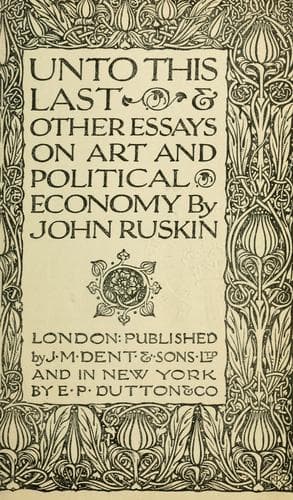
Unto This Last, and Other Essays on Political EconomyRuskin, John
General
Unto This Last, and Other Essays on Political Economy
Ruskin, John
Art; Economics
"Tai Cristian dannera l'Etiope,
Quando si partiranno i due collegi,
L'UNO IN ETERNO RICCO, E L'ALTRO INOPE."
ESSAY IV.
AD VALOREM.
In the last paper we saw that just payment of labour consisted in a
sum of money which would approximately obtain equivalent labour at a
future time: we have now to examine the means of obtaining such
equivalence. Which question involves the definition of Value, Wealth,
Price, and Produce.
None of these terms are yet defined so as to be understood by the
public. But the last, Produce, which one might have thought the
clearest of all, is, in use, the most ambiguous; and the examination
of the kind of ambiguity attendant on its present employment will best
open the way to our work.
In his Chapter on Capital,[44] Mr. J. S. Mill instances, as a
capitalist, a hardware manufacturer, who, having intended to spend a
certain portion of the proceeds of his business in buying plate and
jewels, changes his mind, and "pays it as wages to additional
workpeople." The effect is stated by Mr. Mill to be that "more food is
appropriated to the consumption of productive labourers."
[44] Book I. chap. iv. s. 1. To save space, my future references
to Mr. Mill's work will be by numerals only, as in this
instance, I. iv. 1. Ed. in 2 vols. 8vo, Parker, 1848.
Now I do not ask, though, had I written this paragraph, it would
surely have been asked of me, What is to become of the silversmiths?
If they are truly unproductive persons, we will acquiesce in their
extinction. And though in another part of the same passage, the
hardware merchant is supposed also to dispense with a number of
servants, whose "food is thus set free for productive purposes," I do
not inquire what will be the effect, painful or otherwise, upon the
servants, of this emancipation of their food. But I very seriously
inquire why ironware is produce, and silverware is not? That the
merchant consumes the one, and sells the other, certainly does not
constitute the difference, unless it can be shown (which, indeed, I
perceive it to be becoming daily more and more the aim of tradesmen to
show) that commodities are made to be sold, and not to be consumed.
The merchant is an agent of conveyance to the consumer in one case,
and is himself the consumer in the other:[45] but the labourers are in
either case equally productive, since they have produced goods to the
same value, if the hardware and the plate are both goods.
Public-domain text, read in full here on John Shaqi.
Reviews
Reviews
No reviews yet
Be the first to share your thoughts on this work.
Elsewhere in the archive
Join the Discussion
Join the discussion
Sign in to leave a comment or review.
Sign InorCreate an account