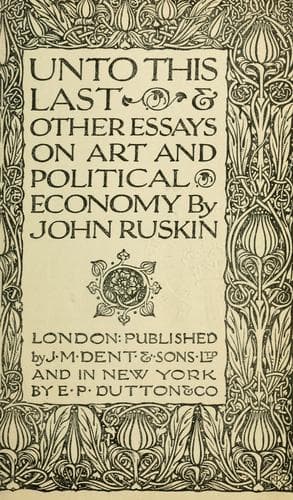
Unto This Last, and Other Essays on Political EconomyRuskin, John
General
Unto This Last, and Other Essays on Political Economy
Ruskin, John
Art; Economics
[45] If Mr. Mill had wished to show the difference in result
between consumption and sale, he should have represented the
hardware merchant as consuming his own goods instead of
selling them; similarly, the silver merchant as consuming
his own goods instead of selling them. Had he done this, he
would have made his position clearer, though less tenable;
and perhaps this was the position he really intended to
take, tacitly involving his theory, elsewhere stated, and
shown in the sequel of this paper to be false, that demand
for commodities is not demand for labour. But by the most
diligent scrutiny of the paragraph now under examination, I
cannot determine whether it is a fallacy pure and simple, or
the half of one fallacy supported by the whole of a greater
one; so that I treat it here on the kinder assumption that
it is one fallacy only.
And what distinction separates them? It is indeed possible that in the
"comparative estimate of the moralist," with which Mr. Mill says
political economy has nothing to do (III. i. 2), a steel fork might
appear a more substantial production than a silver one: we may grant
also that knives, no less than forks, are good produce; and scythes
and ploughshares serviceable articles. But, how of bayonets? Supposing
the hardware merchant to effect large sales of _these_, by help of the
"setting free" of the food of his servants and his silversmith,--is
he still employing productive labourers, or, in Mr. Mill's words,
labourers who increase "the stock of permanent means of enjoyment"
(I. iii. 4)? Or if, instead of bayonets, he supply bombs, will not the
absolute and final "enjoyment" of even these energetically productive
articles (each of which costs ten pounds[46]) be dependent on a proper
choice of time and place for their _enfantement_; choice, that is to
say, depending on those philosophical considerations with which
political economy has nothing to do?[47]
[46] I take Mr. [afterwards Sir A.] Helps' estimate in his essay
on War.
[47] Also when the wrought silver vases of Spain were dashed to
fragments by our custom-house officers, because bullion
might be imported free of duty, but not brains, was the axe
that broke them productive?--the artist who wrought them
unproductive? Or again. If the woodman's axe is productive,
is the executioner's? as also, if the hemp of a cable be
productive, does not the productiveness of hemp in a halter
depend on its moral more than on its material application?
Public-domain text, read in full here on John Shaqi.
Reviews
Reviews
No reviews yet
Be the first to share your thoughts on this work.
Elsewhere in the archive
Join the Discussion
Join the discussion
Sign in to leave a comment or review.
Sign InorCreate an account