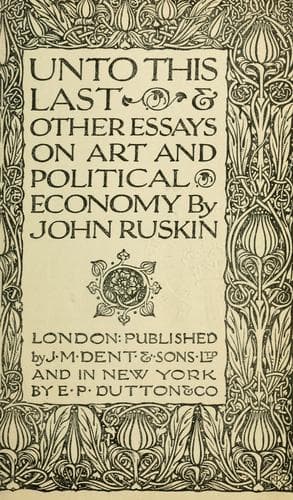
Unto This Last, and Other Essays on Political EconomyRuskin, John
General
Unto This Last, and Other Essays on Political Economy
Ruskin, John
Art; Economics
There appears to be some hitch, I think, in the working even of Mr.
Ricardo's principles; but let him take his own example. "Suppose that
in the early stages of society the bows and arrows of the hunter were
of equal value with the implements of the fisherman. Under such
circumstances the value of the deer, the produce of the hunter's day's
labour, would be _exactly_" (italics mine) "equal to the value of the
fish, the product of the fisherman's day's labour. The comparative
value of the fish and game would be _entirely_ regulated by the
quantity of labour realized in each." (Ricardo, chap. iii. On Value.)
Indeed! Therefore, if the fisherman catches one sprat, and the
huntsman one deer, one sprat will be equal in value to one deer; but
if the fisherman catches no sprat, and the huntsman two deer, no sprat
will be equal in value to two deer?
Nay; but--Mr. Ricardo's supporters may say--he means, on an
average;--if the average product of a day's work of fisher and hunter
be one fish and one deer, the one fish will always be equal in value
to the one deer.
Might I inquire the species of fish. Whale? or whitebait?[50]
[50] Perhaps it may be said, in farther support of Mr. Ricardo,
that he meant, "when the utility is constant or given, the
price varies as the quantity of labour." If he meant this,
he should have said it; but, had he meant it, he could have
hardly missed the necessary result, that utility would be
one measure of price (which he expressly denies it to be);
and that, to prove saleableness, he had to prove a given
quantity of utility, as well as a given quantity of labour:
to wit, in his own instance, that the deer and fish would
each feed the same number of men, for the same number of
days, with equal pleasure to their palates. The fact is, he
did not know what he meant himself. The general idea which
he had derived from commercial experience, without being
able to analyse it, was, that when the demand is constant,
the price varies as the quantity of labour required for
production; or,--using the formula I gave in last
paper--when _y_ is constant, _xy_ varies as _x_. But demand
never is, nor can be, ultimately constant, if _x_ varies
distinctly; for, as price rises, consumers fall away; and as
soon as there is a monopoly (and all scarcity is a form of
monopoly; so that every commodity is affected occasionally
by some colour of monopoly), _y_ becomes the most
influential condition of the price. Thus the price of a
painting depends less on its merit than on the interest
taken in it by the public; the price of singing less on the
labour of the singer than the number of persons who desire
to hear him; and the price of gold less on the scarcity
which affects it in common with cerium or iridium, than on
Public-domain text, read in full here on John Shaqi.
Reviews
Reviews
No reviews yet
Be the first to share your thoughts on this work.
Elsewhere in the archive
Join the Discussion
Join the discussion
Sign in to leave a comment or review.
Sign InorCreate an account