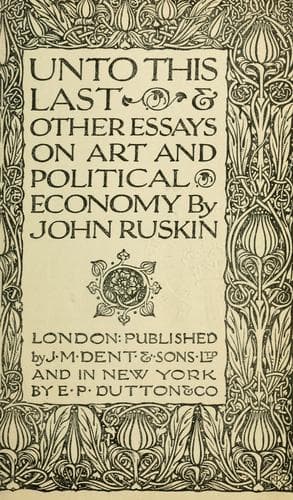
Unto This Last, and Other Essays on Political EconomyRuskin, John
General
Unto This Last, and Other Essays on Political Economy
Ruskin, John
Art; Economics
Similarly: The agreeableness of a thing depends not merely on its own
likeableness, but on the number of people who can be got to like it.
The relative agreeableness, and therefore saleableness, of "a pot of
the smallest ale," and of "Adonis painted by a running brook," depends
virtually on the opinion of Demos, in the shape of Christopher Sly.
That is to say, the agreeableness of a thing depends on its relative
human disposition.[49] Therefore, political economy, being a science
of wealth, must be a science respecting human capacities and
dispositions. But moral considerations have nothing to do with
political economy (III. i. 2). Therefore, moral considerations have
nothing to do with human capacities and dispositions.
[49] These statements sound crude in their brevity; but will
be found of the utmost importance when they are developed.
Thus, in the above instance, economists have never perceived
that disposition to buy is a wholly _moral_ element in
demand: that is to say, when you give a man half-a-crown, it
depends on his disposition whether he is rich or poor with
it--whether he will buy disease, ruin, and hatred, or buy
health, advancement, and domestic love. And thus the
agreeableness or exchange value of every offered commodity
depends on production, not merely of the commodity, but of
buyers of it; therefore on the education of buyers, and on
all the moral elements by which their disposition to buy
this, or that, is formed. I will illustrate and expand into
final consequences every one of these definitions in its
place: at present they can only be given with extremest
brevity; for in order to put the subject at once in a
connected form before the reader, I have thrown into one,
the opening definitions of four chapters; namely, of that on
Value ("Ad Valorem"); on Price ("Thirty Pieces"); on
Production ("Demeter"); and on Economy ("The Law of the
House").
I do not wholly like the look of this conclusion from Mr. Mill's
statements:--let us try Mr. Ricardo's.
"Utility is not the measure of exchangeable value, though it is
absolutely essential to it."--(Chap. 1. sect. i.) Essential to what
degree, Mr. Ricardo? There may be greater and less degrees of utility.
Meat, for instance, may be so good as to be fit for any one to eat, or
so bad as to be fit for no one to eat. What is the exact degree of
goodness which is "essential" to its exchangeable value, but not "the
measure" of it? How good must the meat be, in order to possess any
exchangeable value; and how bad must it be--(I wish this were a
settled question in London markets)--in order to possess none?
Public-domain text, read in full here on John Shaqi.
Reviews
Reviews
No reviews yet
Be the first to share your thoughts on this work.
Elsewhere in the archive
Join the Discussion
Join the discussion
Sign in to leave a comment or review.
Sign InorCreate an account