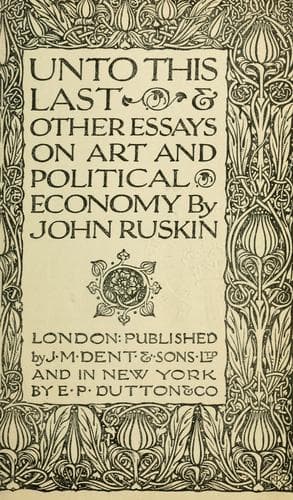
Unto This Last, and Other Essays on Political EconomyRuskin, John
General
Unto This Last, and Other Essays on Political Economy
Ruskin, John
Art; Economics
The real science of political economy, which has yet to be
distinguished from the bastard science, as medicine from witchcraft,
and astronomy from astrology, is that which teaches nations to desire
and labour for the things that lead to life; and which teaches them to
scorn and destroy the things that lead to destruction. And if, in a
state of infancy, they suppose indifferent things, such as
excrescences of shellfish, and pieces of blue and red stone, to be
valuable, and spend large measure of the labour which ought to be
employed for the extension and ennobling of life, in diving or digging
for them, and cutting them into various shapes,--or if, in the same
state of infancy, they imagine precious and beneficent things, such as
air, light, and cleanliness, to be valueless,--or if, finally, they
imagine the conditions of their own existence, by which alone they can
truly possess or use anything, such, for instance, as peace, trust,
and love, to be prudently exchangeable, when the market offers, for
gold, iron, or excrescences of shells--the great and only science of
Political Economy teaches them, in all these cases, what is vanity,
and what substance; and how the service of Death, the Lord of Waste,
and of eternal emptiness, differs from the service of Wisdom, the Lady
of Saving, and of eternal fulness; she who has said, "I will cause
those that love me to inherit SUBSTANCE; and I will FILL their
treasures."
The "Lady of Saving," in a profounder sense than that of the savings'
bank, though that is a good one: Madonna della Salute,--Lady of
Health--which, though commonly spoken of as if separate from wealth,
is indeed a part of wealth. This word, "wealth," it will be
remembered, is the next we have to define.
"To be wealthy," says Mr. Mill, is "to have a large stock of useful
articles."
I accept this definition. Only let us perfectly understand it. My
opponents often lament my not giving them enough logic: I fear I must
at present use a little more than they will like; but this business of
Political Economy is no light one, and we must allow no loose terms in
it.
We have, therefore, to ascertain in the above definition, first, what
is the meaning of "having," or the nature of Possession. Then, what is
the meaning of "useful," or the nature of Utility.
And first of possession. At the crossing of the transepts of Milan
Cathedral has lain, for three hundred years, the embalmed body of St.
Carlo Borromeo. It holds a golden crosier, and has a cross of emeralds
on its breast. Admitting the crosier and emeralds to be useful
articles, is the body to be considered as "having" them? Do they, in
the politico-economical sense of property, belong to it? If not, and
if we may, therefore, conclude generally that a dead body cannot
possess property, what degree and period of animation in the body will
render possession possible?
Public-domain text, read in full here on John Shaqi.
Reviews
Reviews
No reviews yet
Be the first to share your thoughts on this work.
Elsewhere in the archive
Join the Discussion
Join the discussion
Sign in to leave a comment or review.
Sign InorCreate an account