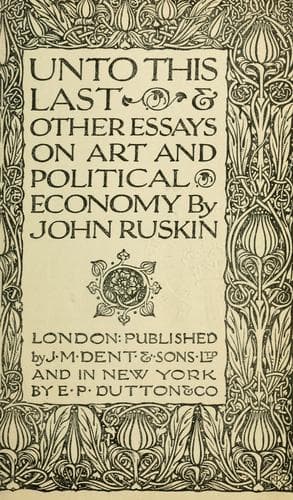
Unto This Last, and Other Essays on Political EconomyRuskin, John
General
Unto This Last, and Other Essays on Political Economy
Ruskin, John
Art; Economics
As thus: lately in a wreck of a Californian ship, one of the
passengers fastened a belt about him with two hundred pounds of gold
in it, with which he was found afterwards at the bottom. Now, as he
was sinking--had he the gold? or had the gold him?[51]
[51] Compare George Herbert, _The Church Porch_, Stanza 28.
And if, instead of sinking him in the sea by its weight, the gold had
struck him on the forehead, and thereby caused incurable
disease--suppose palsy or insanity,--would the gold in that case have
been more a "possession" than in the first? Without pressing the
inquiry up through instances of gradually increasing vital power over
the gold (which I will, however, give, if they are asked for), I
presume the reader will see that possession, or "having," is not an
absolute, but a gradated, power; and consists not only in the quantity
or nature of the thing possessed, but also (and in a greater degree)
in its suitableness to the person possessing it, and in his vital
power to use it.
And our definition of Wealth, expanded, becomes: "The possession of
useful articles, _which we can use_." This is a very serious change.
For wealth, instead of depending merely on a "have," is thus seen to
depend on a "can." Gladiator's death, on a "habet"; but soldier's
victory, and state's salvation, on a "quo plurimum posset." (Liv. VII.
6.) And what we reasoned of only as accumulation of material, is seen
to demand also accumulation of capacity.
So much for our verb. Next for our adjective. What is the meaning of
"useful?"
The inquiry is closely connected with the last. For what is capable of
use in the hands of some persons, is capable, in the hands of others,
of the opposite of use, called commonly, "from-use," or "ab-use." And
it depends on the person, much more than on the article, whether its
usefulness or ab-usefulness will be the quality developed in it. Thus,
wine, which the Greeks, in their Bacchus, made, rightly, the type of
all passion, and which, when used, "cheereth god and man" (that is to
say, strengthens both the divine life, or reasoning power, and the
earthly, or carnal power, of man); yet, when abused, becomes
"Dionusos," hurtful especially to the divine part of man, or reason.
And again, the body itself, being equally liable to use and to abuse,
and, when rightly disciplined, serviceable to the State, both for war
and labour;--but when not disciplined, or abused, valueless to the
State, and capable only of continuing the private or single existence
of the individual (and that but feebly)--the Greeks called such a body
an "idiotic" or "private" body, from their word signifying a person
employed in no way directly useful to the State: whence, finally, our
"idiot," meaning a person entirely occupied with his own concerns.
Public-domain text, read in full here on John Shaqi.
Reviews
Reviews
No reviews yet
Be the first to share your thoughts on this work.
Elsewhere in the archive
Join the Discussion
Join the discussion
Sign in to leave a comment or review.
Sign InorCreate an account