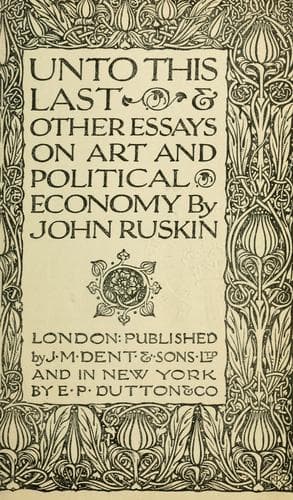
Unto This Last, and Other Essays on Political EconomyRuskin, John
General
Unto This Last, and Other Essays on Political Economy
Ruskin, John
Art; Economics
I have hitherto carefully restricted myself, in speaking of exchange,
to the use of the term "advantage;" but that term includes two ideas:
the advantage, namely, of getting what we _need_, and that of getting
what we _wish for_. Three-fourths of the demands existing in the world
are romantic; founded on visions, idealisms, hopes, and affections;
and the regulation of the purse is, in its essence, regulation of the
imagination and the heart. Hence, the right discussion of the nature
of price is a very high metaphysical and psychical problem; sometimes
to be solved only in a passionate manner, as by David in his counting
the price of the water of the well by the gate of Bethlehem; but its
first conditions are the following:--The price of anything is the
quantity of labour given by the person desiring it, in order to obtain
possession of it. This price depends on four variable quantities. _A_.
The quantity of wish the purchaser has for the thing; opposed to
[Greek: a], the quantity of wish the seller has to keep it. _B_. The
quantity of labour the purchaser can afford, to obtain the thing;
opposed to [Greek: b], the quantity of labour the seller can afford, to
keep it. These quantities are operative only in excess; _i.e._, the
quantity of wish (_A_) means the quantity of wish for this thing, above
wish for other things; and the quantity of work (_B_) means the quantity
which can be spared to get this thing from the quantity needed to get
other things.
Phenomena of price, therefore, are intensely complex, curious, and
interesting--too complex, however, to be examined yet; every one of
them, when traced far enough, showing itself at last as a part of the
bargain of the Poor of the Flock (or "flock of slaughter"), "If ye
think good, give ME my price, and if not, forbear"--Zech. xi. 12; but
as the price of everything is to be calculated finally in labour, it
is necessary to define the nature of that standard.
Labour is the contest of the life of man with an opposite:--the term
"life" including his intellect, soul, and physical power, contending
with question, difficulty, trial, or material force.
Labour is of a higher or lower order, as it includes more or fewer of
the elements of life: and labour of good quality, in any kind,
includes always as much intellect and feeling as will fully and
harmoniously regulate the physical force.
In speaking of the value and price of labour, it is necessary always
to understand labour of a given rank and quality, as we should speak
of gold or silver of a given standard. Bad (that is, heartless,
inexperienced, or senseless) labour cannot be valued; it is like gold
of uncertain alloy, or flawed iron.[54]
Public-domain text, read in full here on John Shaqi.
Reviews
Reviews
No reviews yet
Be the first to share your thoughts on this work.
Elsewhere in the archive
Join the Discussion
Join the discussion
Sign in to leave a comment or review.
Sign InorCreate an account