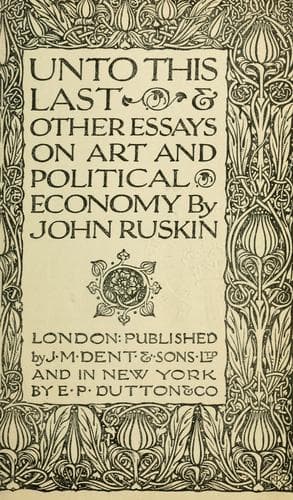
Unto This Last, and Other Essays on Political EconomyRuskin, John
General
Unto This Last, and Other Essays on Political Economy
Ruskin, John
Art; Economics
[54] Labour which is entirely good of its kind, that is to say,
effective, or efficient, the Greeks called "weighable,"
or [Greek: axios], translated usually "worthy," and
because thus substantial and true, they called its price
[Greek: time], the "honourable estimate" of it (honorarium):
this word being founded on their conception of true labour
as a divine thing, to be honoured with the kind of honour
given to the gods; whereas the price of false labour, or of
that which led away from life, was to be, not honour, but
vengeance; for which they reserved another word, attributing
the exaction of such price to a peculiar goddess called
Tisiphone, the "requiter (or quittance-taker) of death;"
a person versed in the highest branches of arithmetic, and
punctual in her habits; with whom accounts current have been
opened also in modern days.
The quality and kind of labour being given, its value, like that of
all other valuable things, is invariable. But the quantity of it which
must be given for other things is variable: and in estimating this
variation, the price of other things must always be counted by the
quantity of labour; not the price of labour by the quantity of other
things.
Thus, if we want to plant an apple sapling in rocky ground, it may
take two hours' work; in soft ground, perhaps only half an hour. Grant
the soil equally good for the tree in each case. Then the value of the
sapling planted by two hours' work is nowise greater than that of the
sapling planted in half an hour. One will bear no more fruit than the
other. Also, one half-hour of work is as valuable as another
half-hour; nevertheless the one sapling has cost four such pieces of
work, the other only one. Now the proper statement of this fact is,
not that the labour on the hard ground is cheaper than on the soft;
but that the tree is dearer. The exchange value may, or may not,
afterwards depend on this fact. If other people have plenty of soft
ground to plant in, they will take no cognizance of our two hours'
labour, in the price they will offer for the plant on the rock. And
if, through want of sufficient botanical science, we have planted an
upas-tree instead of an apple, the exchange value will be a negative
quantity; still less proportionate to the labour expended.
What is commonly called cheapness of labour, signifies, therefore, in
reality, that many obstacles have to be overcome by it; so that much
labour is required to produce a small result. But this should never be
spoken of as cheapness of labour, but as dearness of the object
wrought for. It would be just as rational to say that walking was
cheap, because we had ten miles to walk home to our dinner, as that
labour was cheap, because we had to work ten hours to earn it.
The last word which we have to define is "Production."
Public-domain text, read in full here on John Shaqi.
Reviews
Reviews
No reviews yet
Be the first to share your thoughts on this work.
Elsewhere in the archive
Join the Discussion
Join the discussion
Sign in to leave a comment or review.
Sign InorCreate an account