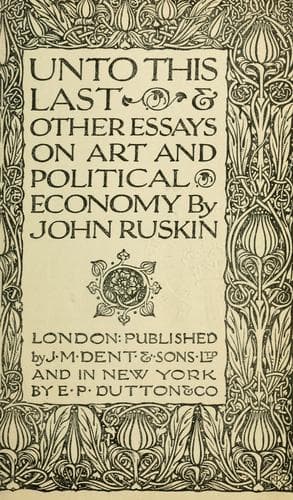
Unto This Last, and Other Essays on Political EconomyRuskin, John
General
Unto This Last, and Other Essays on Political Economy
Ruskin, John
Art; Economics
On the other hand, whatever does not serve either of these
purposes,--much more whatever counteracts them,--is in like manner
useless to man, unwholesome, unhelpful, or unholy; and by seeking such
things man shortens and diminishes his life upon the earth. And
neither with respect to things useful or useless can man's estimate of
them alter their nature. Certain substances being good for his food,
and others noxious to him, what he thinks or wishes respecting them
can neither change their nature, nor prevent their power. If he eats
corn, he will live; if nightshade, he will die. If he produce or make
good and beautiful things, they will "recreate" him (note the
solemnity and weight of the word); if bad and ugly things, they will
"corrupt" or break in pieces--that is, in the exact degree of their
power, kill him. For every hour of labour, however enthusiastic or
well intended, which he spends for that which is not bread, so much
possibility of life is lost to him. His fancies, likings, beliefs,
however brilliant, eager, or obstinate, are of no avail if they are
set on a false object. Of all that he has laboured for, the eternal
law of heaven and earth measures out to him for reward, to the utmost
atom, that part which he ought to have laboured for, and withdraws
from him (or enforces on him, it may be) inexorably that part which he
ought not to have laboured for. The dust and chaff are all, to the
last speck, winnowed away, and on his summer threshing-floor stands
his heap of corn; little or much, not according to his labour, but to
his discretion. No "commercial arrangements," no painting of surfaces
nor alloying of substances, will avail him a pennyweight. Nature asks
of him calmly and inevitably, What have you found, or formed--the
right thing or the wrong? By the right thing you shall live; by the
wrong you shall die.
To thoughtless persons it seems otherwise. The world looks to them as
if they could cozen it out of some ways and means of life. But they
cannot cozen IT; they can only cozen their neighbours. The world is
not to be cheated of a grain; not so much as a breath of its air can
be drawn surreptitiously. For every piece of wise work done, so much
life is granted; for every piece of foolish work, nothing; for every
piece of wicked work, so much death. This is as sure as the courses of
day and night. But when the means of life are once produced, men, by
their various struggles and industries of accumulation or exchange,
may variously gather, waste, restrain, or distribute them;
necessitating, in proportion to the waste or restraint, accurately so
much more death. The rate and range of additional death is measured by
the rate and range of waste, and is inevitable;--the only question
(determined mostly by fraud in peace, and force in war) is, Who is to
die, and how?
Public-domain text, read in full here on John Shaqi.
Reviews
Reviews
No reviews yet
Be the first to share your thoughts on this work.
Elsewhere in the archive
Join the Discussion
Join the discussion
Sign in to leave a comment or review.
Sign InorCreate an account