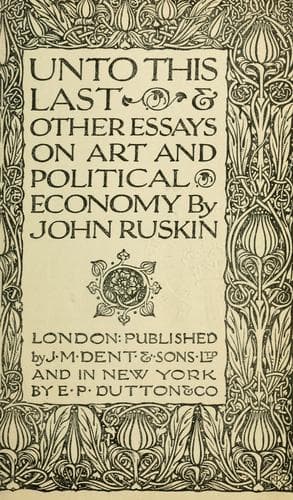
Unto This Last, and Other Essays on Political EconomyRuskin, John
General
Unto This Last, and Other Essays on Political Economy
Ruskin, John
Art; Economics
Such being the everlasting law of human existence, the essential work
of the political economist is to determine what are in reality useful
and life-giving things, and by what degrees and kinds of labour they
are attainable and distributable. This investigation divides itself
under three great heads--first, of Wealth; secondly, of Money; and
thirdly, of Riches.
These terms are often used as synonymous, but they signify entirely
different things. "Wealth," consists of things in themselves valuable;
"Money," of documentary claims to the possession of such things; and
"Riches" is a relative term, expressing the magnitude of the
possessions of one person or society as compared with those of other
persons or societies.
The study of Wealth is a province of natural science:--it deals with
the essential properties of things.
The study of Money is a province of commercial science:--it deals with
conditions of engagement and exchange.
The study of Riches is a province of moral science:--it deals with the
due relations of men to each other in regard of material possessions;
and with the just laws of their association for purposes of labour.
I shall in this paper shortly sketch out the range of subjects which
will come before us as we follow these three branches of inquiry.
SECTION I.--WEALTH.
Wealth, it has been said, consists of things essentially valuable. We
now, therefore, need a definition of "value."
Value signifies the strength or "availing" of anything towards the
sustaining of life, and is always twofold; that is to say, primarily,
INTRINSIC, and, secondarily, EFFECTUAL.
The reader must, by anticipation, be warned against confusing value
with cost, or with price. Value is the life-giving power of anything;
cost, the quantity of labour required to produce it; price, the
quantity of labour which its possessor will take in exchange for it.
Cost and price are commercial conditions, to be studied under the head
of Money.
Intrinsic value is the absolute power of anything to support life. A
sheaf of wheat of given quality and weight has in it a measurable
power of sustaining the substance of the body; a cubic foot of pure
air, a fixed power of sustaining its warmth; and a cluster of flowers
of given beauty, a fixed power of enlivening or animating the senses
and heart.
It does not in the least affect the intrinsic value of the wheat, the
air, or the flowers, that men refuse or despise them. Used or not,
their own power is in them, and that particular power is in nothing
else.
Public-domain text, read in full here on John Shaqi.
Reviews
Reviews
No reviews yet
Be the first to share your thoughts on this work.
Elsewhere in the archive
Join the Discussion
Join the discussion
Sign in to leave a comment or review.
Sign InorCreate an account