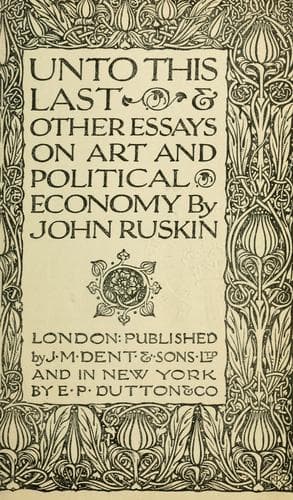
Unto This Last, and Other Essays on Political EconomyRuskin, John
General
Unto This Last, and Other Essays on Political Economy
Ruskin, John
Art; Economics
A. Its value, as a means of producing food and mechanical power,
varies with its form (as mountain or plain), with its substance (in
soil or mineral contents), and with its climate. All these conditions
of intrinsic value, in order to give effectual value, must be known
and complied with by the men who have to deal with it; but at any
given time, or place, the intrinsic value is fixed; such and such a
piece of land, with its associated lakes and seas, rightly treated
in surface and substance, can produce precisely so much food
and power, and no more. Its surface treatment (agriculture) and
substance treatment (practical geology and chemistry), are the
first roots of economical science. By surface treatment, however, I
mean more than agriculture as commonly understood; I mean land
and sea culture;--dominion over both the fixed and the flowing
fields;--perfect acquaintance with the laws of climate, and of
vegetable and animal growth in the given tracts of earth or ocean, and
of their relations regulating especially the production of those
articles of food which, being in each particular spot producible in
the highest perfection, will bring the best price in commercial
exchanges.
B. The second element of value in land is its beauty, united with such
conditions of space and form as are necessary for exercise, or
pleasant to the eye, associated with vital organism.
Land of the highest value in these respects is that lying in temperate
climates, and boldly varied in form; removed from unhealthy or
dangerous influences (as of miasm or volcano); and capable of
sustaining a rich fauna and flora. Such land, carefully tended by the
hand of man, so far as to remove from it unsightlinesses and evidences
of decay; guarded from violence, and inhabited, under man's
affectionate protection, by every kind of living creature that can
occupy it in peace, forms the most precious "property" that human
beings can possess.
The determination of the degree in which these two elements of value
can be united in land, or in which either element must, or should, in
particular cases, be sacrificed to the other, forms the most important
branch of economical inquiry respecting preferences of things.
2. Buildings, furniture, and instruments.
The value of buildings consists--A, in permanent strength, with
convenience of form, of size, and of position; so as to render
employment peaceful, social intercourse easy, temperature and air
healthy. The advisable or possible magnitude of cities and mode of
their distribution in squares, streets, courts, etc., the relative
value of sites of land, and the modes of structure which are
healthiest and most permanent, have to be studied under this head.
B. The value of buildings consists, secondarily, in historical
association and architectural beauty, of which we have to examine the
influence on manners and life.
The value of instruments consists--
Public-domain text, read in full here on John Shaqi.
Reviews
Reviews
No reviews yet
Be the first to share your thoughts on this work.
Elsewhere in the archive
Join the Discussion
Join the discussion
Sign in to leave a comment or review.
Sign InorCreate an account