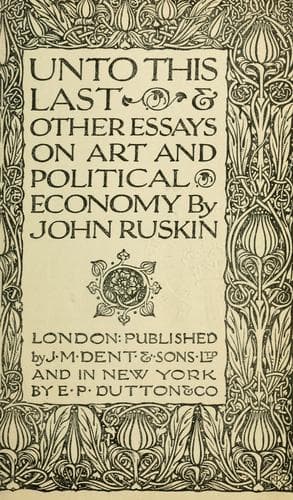
Unto This Last, and Other Essays on Political EconomyRuskin, John
General
Unto This Last, and Other Essays on Political Economy
Ruskin, John
Art; Economics
But in order that this value of theirs may become effectual, a certain
state is necessary in the recipient of it. The digesting, the
breathing, and perceiving functions must be perfect in the human
creature before the food, air, or flowers can become their full value
to it. The production of effectual value, therefore, always involves
two needs; first, the production of a thing essentially useful; then
the production of the capacity to use it. Where the intrinsic value
and acceptant capacity come together there is EFFECTUAL value, or
wealth. Where there is either no intrinsic value, or no acceptant
capacity, there is no effectual value; that is to say, no wealth. A
horse is no wealth to us if we cannot ride, nor a picture if we cannot
see, nor can any noble thing be wealth, except to a noble person. As
the aptness of the user increases, the effectual value of the thing
used increases; and in its entirety can co-exist only with perfect
skill of use, or harmony of nature. The effectual value of a given
quantity of any commodity existing in the world at any moment is
therefore a mathematical function of the capacity existing in the
human race to enjoy it. Let its intrinsic value be represented by _x_,
and the recipient faculty by _y_; its effectual value is _x y_, in
which the sum varies as either co-efficient varies, is increased by
either's increase,[68] and cancelled by either's absence.
[68] With this somewhat strange and ungeometrical limitation,
however, which, here expressed for the moment in the
briefest terms, we must afterwards trace in detail--that _x
y_ may be indefinitely increased by the increase of _y_
only; but not by the increase of _x_, unless _y_ increases
also in a fixed proportion.
Valuable material things may be conveniently referred to five heads:--
1. Land, with an associated air, water, and organisms.
2. Houses, furniture, and instruments.
3. Stored or prepared food and medicine, and articles of bodily
luxury, including clothing.
4. Books.
5. Works of art.
We shall enter into separate inquiry as to the conditions of value
under each of these heads. The following sketch of the entire subject
may be useful for future reference:--
1. Land. Its value is twofold--
A. As producing food and mechanical power.
B. As an object of sight and thought, producing intellectual power.
Public-domain text, read in full here on John Shaqi.
Reviews
Reviews
No reviews yet
Be the first to share your thoughts on this work.
Elsewhere in the archive
Join the Discussion
Join the discussion
Sign in to leave a comment or review.
Sign InorCreate an account