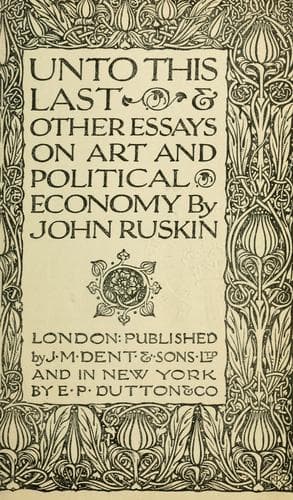
Unto This Last, and Other Essays on Political EconomyRuskin, John
General
Unto This Last, and Other Essays on Political Economy
Ruskin, John
Art; Economics
If all the money in the world, notes and gold, were destroyed in an
instant, it would leave the world neither richer nor poorer than it
was. But it would leave the individual inhabitants of it in different
relations.
Money is, therefore, correspondent in its nature to the title-deed of
an estate. Though the deed be burned, the estate still exists, but the
right to it has become disputable.
The worth of money remains unchanged, as long as the proportion of the
quantity of existing money to the quantity of existing wealth, or
available labour which it professes to represent, remains unchanged.
If the wealth increases, but not the money, the worth of the money
increases; if the money increases, but not the wealth, the worth of
the money diminishes.
Money, therefore, cannot be arbitrarily multiplied, any more than
title-deeds can. So long as the existing wealth or available labour is
not fully represented by the currency, the currency may be increased
without diminution of the assigned worth of its pieces. But when the
existing wealth, or available labour, is once fully represented, every
piece of money thrown into circulation diminishes the worth of every
other existing piece, in the proportion it bears to the number of
them, provided the new piece be received with equal credit; if not,
the depreciation of worth takes place exclusively in the new piece,
according to the inferiority of its credit.
When, however, new money, composed of some substance of supposed
intrinsic value (as of gold), is brought into the market, or when new
notes are issued which are supposed to be deserving of credit, the
desire to obtain money will, under certain circumstances, stimulate
industry; an additional quantity of wealth is immediately produced,
and if this be in proportion to the new claims advanced, the value of
the existing currency is undepreciated. If the stimulus given be so
great as to produce more goods than are proportioned to the additional
coinage, the worth of the existing currency will be raised.
Arbitrary control and issues of currency affect the production of
wealth, by acting on the hopes and fears of men; and are, under
certain circumstances, wise. But the issue of additional currency to
meet the exigencies of immediate expense, is merely one of the
disguised forms of borrowing or taxing.
Public-domain text, read in full here on John Shaqi.
Reviews
Reviews
No reviews yet
Be the first to share your thoughts on this work.
Elsewhere in the archive
Join the Discussion
Join the discussion
Sign in to leave a comment or review.
Sign InorCreate an account