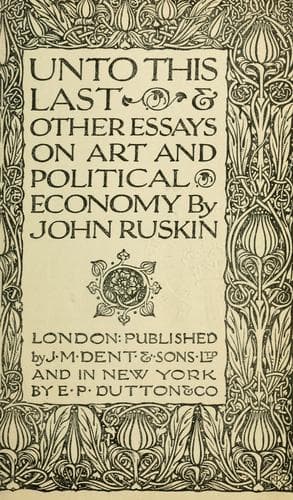
Unto This Last, and Other Essays on Political EconomyRuskin, John
General
Unto This Last, and Other Essays on Political Economy
Ruskin, John
Art; Economics
It is, however, in the present low state of economical knowledge,
often possible for Governments to venture on an issue of currency,
when they could not venture on an additional loan or tax, because the
real operation of such issue is not understood by the people, and the
pressure of it is irregularly distributed, and with an unperceived
gradation. Finally, the use of substances of intrinsic value as the
materials of a currency, is a barbarism;--a remnant of the conditions
of barter, which alone can render commerce possible among savage
nations. It is, however, still necessary, partly as a mechanical check
on arbitrary issues; partly as a means of exchanges with foreign
nations. In proportion to the extension of civilization, and increase
of trustworthiness in Governments, it will cease. So long as it
exists, the phenomena of the cost and price of the articles used for
currency, are mingled with those of currency itself, in an almost
inextricable manner; and the worth of money in the market is affected
by multitudinous accidental circumstances, which have been traced,
with more or less success, by writers on commercial operations; but
with these variations the true political economist has no more to do
than an engineer fortifying a harbour of refuge against Atlantic tide,
has to concern himself with the cries or quarrels of children who dig
pools with their fingers for its ebbing currents among the sand.
SECTION III.--RICHES.
According to the various industry, capacity, good fortune, and desires
of men, they obtain greater or smaller share of, and claim upon, the
wealth of the world.
The inequalities between these shares, always in some degree just and
necessary, may be either restrained by law (or circumstance) within
certain limits; or may increase indefinitely.
Where no moral or legal restraint is put upon the exercise of the will
and intellect of the stronger, shrewder, or more covetous men, these
differences become ultimately enormous. But as soon as they become so
distinct in their extremes as that, on one side, there shall be
manifest redundance of possession, and on the other manifest pressure
of need,--the terms "riches" and "poverty" are used to express the
opposite states; being contrary only in the manner of the terms
"warmth" and "cold"; which neither of them imply an actual degree, but
only a relation to other degrees, of temperature.
Public-domain text, read in full here on John Shaqi.
Reviews
Reviews
No reviews yet
Be the first to share your thoughts on this work.
Elsewhere in the archive
Join the Discussion
Join the discussion
Sign in to leave a comment or review.
Sign InorCreate an account