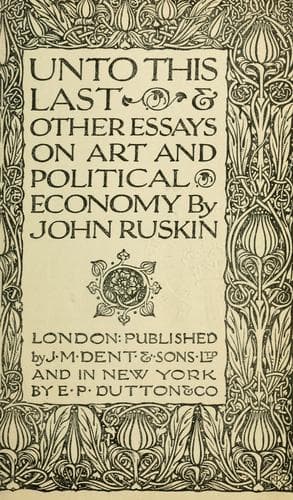
Unto This Last, and Other Essays on Political EconomyRuskin, John
General
Unto This Last, and Other Essays on Political Economy
Ruskin, John
Art; Economics
The labour of life, under such conditions, would probably be neither
zealous nor cheerful; yet the only difference between this position
and that of the ordinary capitalist is the power which the latter
delights in supposing himself to possess, and which is attributed to
him by others, of spending his money at any moment. This pleasure,
taken in the imagination of power to part with that which we have no
intention of parting with, is one of the most curious though commonest
forms of Eidolon, or Phantasm of Wealth. But the political economist
has nothing to do with this idealism, and looks only to the practical
issue of it,--namely, that the holder of wealth, in such temper,
may be regarded simply as a mechanical means of collection;
or as a money-chest with a slit in it,[72] set in the public
thoroughfare;--chest of which only Death has the key, and probably
Chance the distribution of contents. In his function of lender (which,
however, is one of administration, not use, as far as he is himself
concerned), the capitalist takes, indeed, a more interesting aspect;
but even in that function, his relations with the state are apt to
degenerate into a mechanism for the convenient contraction of debt;--a
function the more mischievous, because a nation invariably appeases
its conscience with respect to an unjustifiable expense by meeting it
with borrowed funds,--expresses its repentance of a foolish piece of
business by letting its tradesmen wait for their money,--and always
leaves its descendants to pay for the work which will be of the least
service to them.[73]
[72] The orifice being not merely of a receptant, but of a
suctional character. Among the types of human virtue and
vice presented grotesquely by the lower animals, perhaps
none is more curiously definite that that of avarice in the
Cephalopod, a creature which has a purse for a body; a
hawk's beak for a mouth; suckers for feet and hands; and
whose house is its own skeleton.
[73] It would be well if a somewhat dogged conviction could
be enforced on nations as on individuals, that, with few
exceptions, what they cannot at present pay for, they should
not at present have.
Public-domain text, read in full here on John Shaqi.
Reviews
Reviews
No reviews yet
Be the first to share your thoughts on this work.
Elsewhere in the archive
Join the Discussion
Join the discussion
Sign in to leave a comment or review.
Sign InorCreate an account