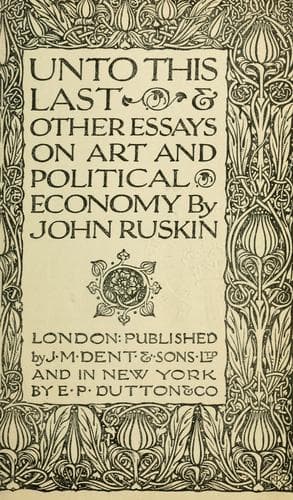
Unto This Last, and Other Essays on Political EconomyRuskin, John
General
Unto This Last, and Other Essays on Political Economy
Ruskin, John
Art; Economics
There is a strange fallacy running at this time through all
talk about free trade. It is continually assumed that every
kind of Government interference takes away liberty of trade.
Whereas liberty is lost only when interference hinders, not
when it helps. You do not take away a man's freedom by
showing him his road--nor by making it smoother for him (not
that it is always desirable to do so, but it may be); nor
even by fencing it for him, if there is an open ditch at the
side of it. The real mode in which protection interferes
with liberty, and the real evil of it, is not in its
"protecting" one person, but in its hindering another; a
form of interference which invariably does most mischief to
the person it is intended to serve, which the Northern
Americans are about discomfortably to discover, unless they
think better of it. There is also a ludicrous confusion in
many persons' minds between protection and encouragement;
they differ materially. "Protection" is saying to
the commercial schoolboy, "Nobody shall hit you."
"Encouragement," is saying to him, "That's the way to
hit."
[75] The question of equivalence (namely, how much wine a man
is to receive in return for so much corn, or how much coal
in return for so much iron) is a quite separate one, which
we will examine presently. For the time let it be assumed
that this equivalence has been determined, and that the
Government order in exchange for a fixed weight of any
article (called, suppose, _a_), is either for the return of
that weight of the article itself, or of another fixed
weight of the article _b_, or another of the article _c_,
and so on.
We hitherto consider the Government itself as simply a conservative
power, taking charge of the wealth entrusted to it.
But a Government may be far other than a conservative power. It may be
on the one hand constructive, on the other destructive.
If a constructive, or improving power, using all the wealth entrusted
to it to the best advantage, the nation is enriched in root and branch
at once, and the Government is enabled for every order presented, to
return a quantity of wealth greater than the order was written for,
according to the fructification obtained in the interim.[76]
[76] The reader must be warned in advance that the conditions
here supposed have nothing to do with the "interest" of
money commonly so called.
Public-domain text, read in full here on John Shaqi.
Reviews
Reviews
No reviews yet
Be the first to share your thoughts on this work.
Elsewhere in the archive
Join the Discussion
Join the discussion
Sign in to leave a comment or review.
Sign InorCreate an account