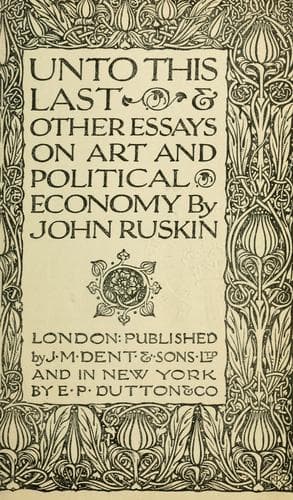
Unto This Last, and Other Essays on Political EconomyRuskin, John
General
Unto This Last, and Other Essays on Political Economy
Ruskin, John
Art; Economics
This ability may be either concealed, in which case the currency does
not completely represent the wealth of the country, or it may be
manifested by the continual payment of the excess of value on each
order, in which case there is (irrespectively, observe, of collateral
results afterwards to be examined) a perpetual rise in the worth of
the currency, that is to say, a fall in the price of all articles
represented by it.
But if the Government be destructive, or a consuming power, it becomes
unable to return the value received on the presentation of the order.
This inability may either (A), be concealed by meeting demands to the
full, until it issue in bankruptcy, or in some form of national
debt;--or (B), it may be concealed during oscillatory movements
between destructiveness and productiveness, which result on the whole
in stability;--or (C), it may be manifested by the consistent return
of less than value received on each presented order, in which case
there is a consistent fall in the worth of the currency, or rise in
the price of the things represented by it.
Now, if for this conception of a central Government, we substitute
that of another body of persons occupied in industrial pursuits, of
whom each adds in his private capacity to the common store: so that
the store itself, instead of remaining a public property of
ascertainable quantity, for the guardianship of which a body of public
men are responsible, becomes disseminated private property, each man
giving in exchange for any article received from another, a general
order for its equivalent in whatever other article the claimant may
desire (such general order being payable by any member of the society
in whose possession the demanded article may be found), we at once
obtain an approximation to the actual condition of a civilized
mercantile community from which approximation we might easily proceed
into still completer analysis. I purpose, however, to arrive at every
result by the gradual expansion of the simpler conception; but I wish
the reader to observe, in the meantime, that both the social
conditions thus supposed (and I will by anticipation say also all
possible social conditions) agree in two great points; namely, in the
primal importance of the supposed national store or stock, and in its
destructibility or improvability by the holders of it.
I. Observe that in both conditions, that of central
Government-holding, and diffused private-holding, the quantity of
stock is of the same national moment. In the one case, indeed, its
amount may be known by examination of the persons to whom it is
confided; in the other it cannot be known but by exposing the private
affairs of every individual. But, known or unknown, its significance
is the same under each condition. The riches of the nation consist in
the abundance, and their wealth depends on the nature of this store.
Public-domain text, read in full here on John Shaqi.
Reviews
Reviews
No reviews yet
Be the first to share your thoughts on this work.
Elsewhere in the archive
Join the Discussion
Join the discussion
Sign in to leave a comment or review.
Sign InorCreate an account