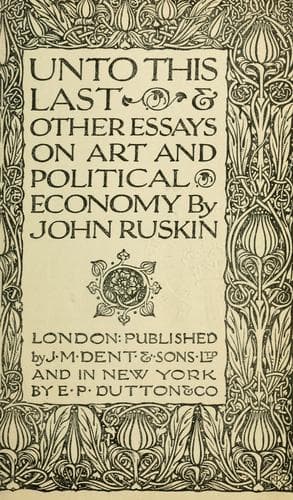
Unto This Last, and Other Essays on Political EconomyRuskin, John
General
Unto This Last, and Other Essays on Political Economy
Ruskin, John
Art; Economics
The statement, caricatured as it may seem, is only exaggerated in
assuming the persistence of the folly to extremity, unchecked, as in
reality it would be, by the gradual rise in price of food. But it
falls short of the actual facts of human life in expression of the
depth and intensity of the folly itself. For a great part (the reader
would not believe how great until he saw the statistics in detail) of
the most earnest and ingenious industry of the world is spent in
producing munitions of war; gathering that is to say the materials,
not of festive, but of consuming fire; filling its stores with all
power of the instruments of pain, and all affluence of the ministries
of death. It was no true Trionfo della Morte which men have seen and
feared (sometimes scarcely feared) so long;--wherein he brought them
rest from their labours. We see and share another and higher form of
his triumph now. Task-master instead of Releaser, he rules the dust of
the arena no less than of the tomb; and, content once in the grave
whither man went, to make his works cease and his devices to
vanish,--now, in the busy city and on the serviceable sea, makes his
work to increase, and his devices to multiply.
To this doubled loss, or negative power of labour, spent in producing
means of destruction, we have to add in our estimate of the
consequences of human folly, whatever more insidious waste of toil
there is in the production of unnecessary luxury. Such and such an
occupation (it is said) supports so many labourers, because so many
obtain wages in following it; but it is never considered that unless
there be a supporting power in the product of the occupation, the
wages given to one man are merely withdrawn from another. We cannot
say of any trade that it maintains such and such a number of persons,
unless we know how and where the money, now spent in the purchase of
its produce, would have been spent, if that produce had not been
manufactured. The purchasing funds truly support a number of people in
making This; but (probably) leave unsupported an equal number who are
making, or could have made That. The manufacturers of small watches
thrive in Geneva;--it is well;--but where would the money spent on
small watches have gone, had there been no small watches to buy?
Public-domain text, read in full here on John Shaqi.
Reviews
Reviews
No reviews yet
Be the first to share your thoughts on this work.
Elsewhere in the archive
Join the Discussion
Join the discussion
Sign in to leave a comment or review.
Sign InorCreate an account