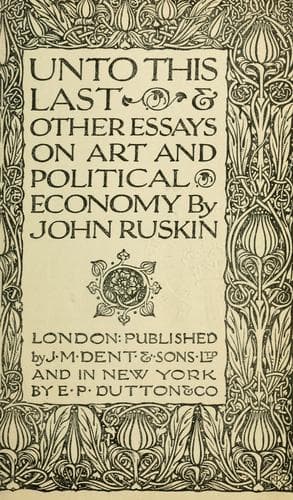
Unto This Last, and Other Essays on Political EconomyRuskin, John
General
Unto This Last, and Other Essays on Political Economy
Ruskin, John
Art; Economics
If the so frequently uttered aphorism of mercantile economy--"labour
is limited by capital"--were true, this question would be a definite
one. But it is untrue; and that widely. Out of a given quantity of
wages, more or less labour is to be had, according to the quantity of
will with which we can inspire the workman; and the true limit of
labour is only in the limit of this moral stimulus of the will, and
the bodily power. In an ultimate, but entirely practical sense, labour
is limited by capital, as it is by matter--that is to say, where there
is no material, there can be no work--but in the practical sense,
labour is limited only by the great original capital[77] of Head,
Heart, and Hand. Even in the most artificial relations of commerce, it
is to capital as fire to fuel: out of so much fuel you shall have so
much fire--not in proportion to the mass of combustibles, but to the
force of wind that fans and water that quenches; and the appliance of
both. And labour is furthered, as conflagration is, not so much by
added fuel, as by admitted air.
[77] The aphorism, being hurried English for "labour is limited
by want of capital," involves also awkward English in its
denial, which cannot be helped.
For which reasons, I had to insert, above, the qualifying "probably";
for it can never be said positively that the purchase money, or wages
fund of any trade is withdrawn from some other trade. The object
itself may be the stimulus of the production of the money which buys
it; that is to say, the work by which the purchaser obtained the means
of buying it would not have been done by him, unless he had wanted
that particular thing. And the production of any article not
intrinsically (nor in the process of manufacture) injurious, is
useful, if the desire of it causes productive labour in other
directions.
In the national store, therefore, the presence of things intrinsically
valueless does not imply an entirely correlative absence of things
valuable. We cannot be certain that all the labour spent on vanity has
been diverted from reality, and that for every bad thing produced, a
precious thing has been lost. In great measure, the vain things
represent the results of roused indolence; they have been carved, as
toys, in extra time; and, if they had not been made, nothing else
would have been made. Even to munitions of war this principle applies;
they partly represent the work of men who, if they had not made
spears, would never have made pruning-hooks, and who are incapable of
any activities but those of contest.
Public-domain text, read in full here on John Shaqi.
Reviews
Reviews
No reviews yet
Be the first to share your thoughts on this work.
Elsewhere in the archive
Join the Discussion
Join the discussion
Sign in to leave a comment or review.
Sign InorCreate an account