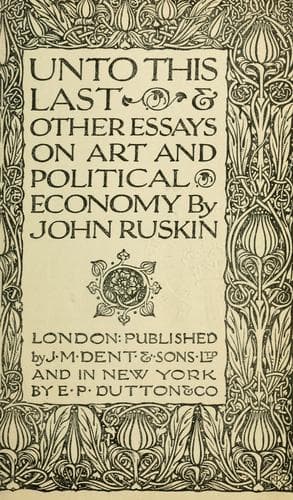
Unto This Last, and Other Essays on Political EconomyRuskin, John
General
Unto This Last, and Other Essays on Political Economy
Ruskin, John
Art; Economics
Thus, then, finally, the nature of the store has to be considered
under two main lights, the one, that of its immediate and actual
utility; the other, that of the past national character which it
signifies by its production, and future character which it must
develop by its uses. And the issue of this investigation will be to
show us that Economy does not depend merely on principles of "demand
and supply," but primarily on what is demanded, and what is supplied.
Question Second. What is the quantity of the store in relation to the
population? It follows from what has been already stated that the
accurate form in which this question has to be put is--"What quantity
of each article composing the store exists in proportion to the real
need for it by the population?" But we shall for the time assume, in
order to keep all our terms at the simplest, that the store is wholly
composed of useful articles, and accurately proportioned to the
several needs of them.
Now it does not follow, because the store is large in proportion to
the number of people, that the people must be in comfort, nor because
it is small, that they must be in distress. An active and economical
race always produces more than it requires, and lives (if it is
permitted to do so) in competence on the produce of its daily labour.
The quantity of its store, great or small, is therefore in many
respects indifferent to it, and cannot be inferred by its aspect.
Similarly an inactive and wasteful population, which cannot live by
its daily labour, but is dependent, partly or wholly, on consumption
of its store, may be (by various difficulties hereafter to be
examined, in realization of getting at such store) retained in a state
of abject distress, though its possessions may be immense. But the
results always involved in the magnitude of store are, the commercial
power of the nation, its security, and its mental character. Its
commercial power, in that according to the quantity of its store, may
be the extent of its dealings; its security, in that according to the
quantity of its store are its means of sudden exertion or sustained
endurance; and its character, in that certain conditions of
civilization cannot be attained without permanent and continually
accumulating store, of great intrinsic value, and of peculiar nature.
Now, seeing that these three advantages arise from largeness of store
in proportion to population, the question arises immediately, "Given
the store--is the nation enriched by diminution of its numbers? Are a
successful national speculation and a pestilence, economically the
same thing?"
Public-domain text, read in full here on John Shaqi.
Reviews
Reviews
No reviews yet
Be the first to share your thoughts on this work.
Elsewhere in the archive
Join the Discussion
Join the discussion
Sign in to leave a comment or review.
Sign InorCreate an account