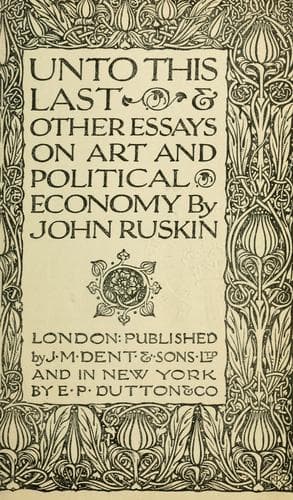
Unto This Last, and Other Essays on Political EconomyRuskin, John
General
Unto This Last, and Other Essays on Political Economy
Ruskin, John
Art; Economics
I have already defined labour to be the Contest of the life of man
with an opposite.[79] Literally, it is the quantity of "Lapse," loss,
or failure of human life caused by any effort. It is usually confused
with effort itself, or the application of power (opera); but there is
much effort which is merely a mode of recreation, or of pleasure. The
most beautiful actions of the human body and the highest results of
the human intelligence, are conditions, or achievements, of quite
unlaborious, nay, of recreative, effort. But labour is the suffering
in effort. It is the negative quantity, or quantity of de-feat which
has to be counted against every Feat, and of de-fect which has to be
counted against every Fact, or Deed of men. In brief, it is "that
quantity of our toils which we die in."
[79] That is to say, its only price is its return. Compare
"Unto This Last," p. 162 and what follows.
We might, therefore, a priori, conjecture (as we shall ultimately
find) that it cannot be bought, nor sold. Everything else is bought
and sold for Labour, but labour itself cannot be bought nor sold for
anything, being priceless.[80] The idea that it is a commodity to be
bought or sold, is the alpha and omega of Politico-Economic fallacy.
[80] The object of Political Economy is not to buy, nor to sell
labour,--but to spare it. Every attempt to buy or sell it
is, in the outcome, ineffectual;--so far as successful, it
is not sale, but Betrayal; and the purchase money is a part
of that typical thirty pieces which bought, first the
greatest of labours, and afterwards the burial field of the
Stranger; for this purchase-money, being in its very
smallness or vileness the exactly measured opposite of
"vilis annona amicorum," makes all men strangers to each
other.
This being the nature of labour, the "Cost" of anything is the
quantity of labour necessary to obtain it;--the quantity for which, or
at which, it "stands" (constat). It is literally the "Constancy" of
the thing;--you shall win it--move it--come at it--for no less than
this.
Cost is measured and measurable only in "labor," not in "opera."[81]
It does not matter how much power a thing needs to produce it; it
matters only how much distress. Generally the more power it requires,
the less the distress; so that the noblest works of man cost less than
the meanest.
Public-domain text, read in full here on John Shaqi.
Reviews
Reviews
No reviews yet
Be the first to share your thoughts on this work.
Elsewhere in the archive
Join the Discussion
Join the discussion
Sign in to leave a comment or review.
Sign InorCreate an account