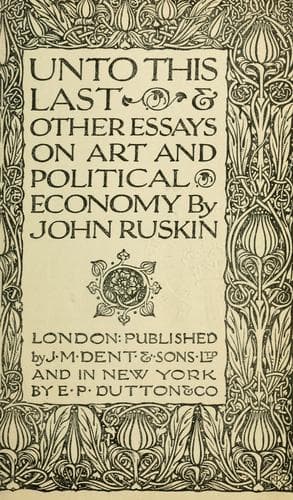
Unto This Last, and Other Essays on Political EconomyRuskin, John
General
Unto This Last, and Other Essays on Political Economy
Ruskin, John
Art; Economics
[81] Cicero's distinction, "sordidi quaestus, quorum operae, non
quorum artes emuntur," admirable in principle, is inaccurate
in expression, because Cicero did not practically know how
much operative dexterity is necessary in all the higher
arts; but the cost of this dexterity is incalculable. Be
it great or small, the "cost" of the mere authority and
perfectness of touch in a hammerstroke of Donatello's, or a
pencil touch of Correggio's, is inestimable by any ordinary
arithmetic. (The best masters themselves usually estimate it
at sums varying from two to three or four shillings a day,
with wine or soup extra.)
True labour, or spending of life, is either of the body, in fatigue
or pain, of the temper or heart (as in perseverance of search for
things,--patience in waiting for them,--fortitude or degradation in
suffering for them, and the like), or of the intellect. All these
kinds of labour are supposed to be included in the general term, and
the quantity of labour is then expressed by the time it lasts. So that
a unit of labour is "an hour's work" or a day's work, as we may
determine.[82]
[82] Only observe, as some labour is more destructive of life
than other labour, the hour or day of the more destructive
toil is supposed to include proportionate rest. Though men
do not, or cannot, usually take such rest, except in death.
Cost, like value, is both intrinsic and effectual. Intrinsic cost is
that of getting the thing in the right way; effectual cost is that of
getting the thing in the way we set about it. But intrinsic cannot be
made a subject of analytical investigation, being only partially
discoverable, and that by long experience. Effectual cost is all that
the political economist can deal with; that is to say, the cost of the
thing under existing circumstances and by known processes.
Cost (irrespectively of any question of demand or supply) varies with
the quantity of the thing wanted, and with the number of persons who
work for it. It is easy to get a little of some things, but difficult
to get much; it is impossible to get some things with few hands, but
easy to get them with many.
The cost and value of things, however difficult to determine
accurately, are thus both dependent on ascertainable physical
circumstances.[83]
Public-domain text, read in full here on John Shaqi.
Reviews
Reviews
No reviews yet
Be the first to share your thoughts on this work.
Elsewhere in the archive
Join the Discussion
Join the discussion
Sign in to leave a comment or review.
Sign InorCreate an account